Turmeric Benefits and Side Effects: An Ayurvedic Guide for Vata, Pitta, and Kapha
Turmeric is powerful, but Ayurveda says it is not for everyone. Learn how Haridra affects Vata, Pitta, and Kapha, when to use it, when to avoid it, and how to think about food-level turmeric versus concentrated curcumin supplements.
Is Turmeric Good for Everyone?
Turmeric may support inflammation, digestion, skin health, and Kapha-type heaviness, but Ayurveda does not consider it right for everyone. Turmeric is heating, light, rough, bitter, and pungent, which means it may aggravate Pitta heat or Vata dryness when overused. It is often best suited for Kapha body types and is generally more appropriate in colder months, especially October through April in much of the U.S. and Canada.
The most important Ayurvedic question is not simply, “Is turmeric healthy?” It is: “Is turmeric right for your body type, digestion, season, symptoms, and current state of balance?”
People Also Ask
Is turmeric good for all body types?
No. Ayurveda teaches that turmeric is not ideal for every body type. It often supports Kapha but may aggravate Pitta heat or Vata dryness when used excessively.
What dosha should avoid too much turmeric?
Pitta types should be most cautious with turmeric, especially if they have acidity, burning sensations, rashes, loose stools, or heat-related inflammation. Vata types should also avoid dry, high-dose turmeric use.
What is the best season to take turmeric?
For much of the U.S. and Canada, turmeric is usually best from October through April, when colder and heavier weather makes Kapha more likely to accumulate.
Is turmeric safe as a supplement?
Turmeric in food is generally different from high-dose curcumin supplements. Supplements may interact with medications and, in rare cases, have been linked with liver injury, especially high-bioavailability forms.
Is turmeric the same as curcumin?
No. Turmeric is the whole rhizome of Curcuma longa. Curcumin is one of turmeric’s active compounds. Many modern supplements isolate or concentrate curcumin, which is not the same as using turmeric as a culinary spice.
Introduction: The Golden Spice Needs a Wiser Conversation
Turmeric has become one of the most celebrated herbs in the West. It is added to lattes, smoothies, capsules, gummies, skincare products, inflammation protocols, longevity stacks, and “superfood” blends. Scroll through wellness media and you may think turmeric is almost universally good for every person, every season, and every symptom.
Ayurveda takes a more refined view. In Ayurveda, turmeric is known as Haridra. It is valued for digestion, skin, blood cleansing, Kapha balance, wound support, and inflammatory conditions. But Ayurveda also teaches that no herb is universally beneficial.
Modern research is interested mainly in curcumin, one of turmeric’s active compounds. Ayurveda studies the whole herb through taste, qualities, potency, post-digestive effect, dosha impact, season, digestion, strength, age, and context.
Ancient Ayurvedic Reference: Haridra in the Classical Tradition
The Charaka Samhita, one of Ayurveda’s foundational texts, identifies Haridra as turmeric and places it within therapeutic groupings connected to cleansing, scraping, skin-related, and detoxification-supportive contexts.
Haridra is described as having bitter and pungent taste, hot potency, pungent post-digestive effect, and rough, light qualities. This explains why turmeric may help with heaviness and Kapha accumulation, but may aggravate dryness, heat, acidity, or burning in some people.
What Is Turmeric?
Turmeric comes from the rhizome of Curcuma longa, a plant in the ginger family. It has been used for centuries in Indian cooking, ritual, skincare, and traditional medicine. Its golden-yellow color comes largely from curcuminoids, especially curcumin.
In everyday food, turmeric is usually consumed in small amounts as part of a cooked meal with fat, spices, vegetables, grains, or legumes. In modern wellness culture, turmeric is often extracted, concentrated, combined with black pepper extract, and sold in capsules at doses far beyond normal culinary use.
Turmeric in Ayurveda: Haridra, Agni, Ama, and Dosha
In Ayurveda, turmeric is not viewed as a generic supplement. It is understood through Agni, Ama, Dosha, Rasa, Virya, Vipaka, Guna, Srotas, Kala, and Matra.
Turmeric’s bitter and pungent taste, hot potency, pungent post-digestive effect, light quality, and rough quality make it especially useful when there is Kapha-type heaviness, sluggish digestion, mucus, swelling, or sticky inflammatory accumulation. But these same qualities can become problematic in Vata dryness or Pitta heat.
Modern Research: What Turmeric May Do for the Body
Modern studies suggest turmeric and curcumin may influence several biological pathways. Curcumin has been studied for antioxidant activity, inflammation signaling, joint discomfort, metabolic markers, liver-related measures, mood, and cognitive outcomes. However, the strength of evidence varies by condition, formulation, dose, and study quality.
The current evidence does not support turmeric as a universal cure-all. Ayurveda would agree: a herb is not judged only by its benefits. It is judged by its fit.
Turmeric, Inflammation, and Oxidative Stress
Curcumin is widely studied for anti-inflammatory and antioxidant effects. Ayurvedically, turmeric may be more appropriate for Kapha-type inflammation that feels heavy, cold, swollen, sluggish, sticky, or congested. It may be less appropriate for Pitta-type burning heat or Vata-type dryness and depletion.
Turmeric and Joint Pain
Turmeric may be more appropriate when joint discomfort is associated with Kapha-type heaviness, swelling, stiffness, or sluggish circulation. It may be less appropriate when the joint condition is dominated by severe dryness, cracking, wasting, sharp burning pain, or high Pitta heat.
Turmeric, Digestion, Agni, and Metabolism
In Ayurveda, turmeric is often used to support digestion and reduce ama-like accumulation. It may support people who feel heavy after meals or tend toward mucus and dampness. It may be less suitable for burning acidity, gastritis-like irritation, heat-driven loose stools, or ulcer-like symptoms.
Turmeric, Skin, and Blood Cleansing Traditions
Classically, turmeric is linked with skin support and cleansing actions. It may be helpful when skin issues show Kapha-type congestion, oiliness, itching, sluggish healing, or inflammatory buildup. For red, burning, reactive Pitta-type skin, internal high-dose turmeric may need caution.
What Turmeric May Do for the Mind
The mind is not separate from digestion in Ayurveda. Turmeric may indirectly support mood when heaviness, inflammation, sluggish digestion, and Kapha-type dullness contribute to low motivation or mental fog. But in Vata anxiety, insomnia, depletion, or dryness, too much turmeric may increase lightness and dryness. In Pitta irritability, anger, acidity, or burning sensations, turmeric’s hot potency may be too stimulating.
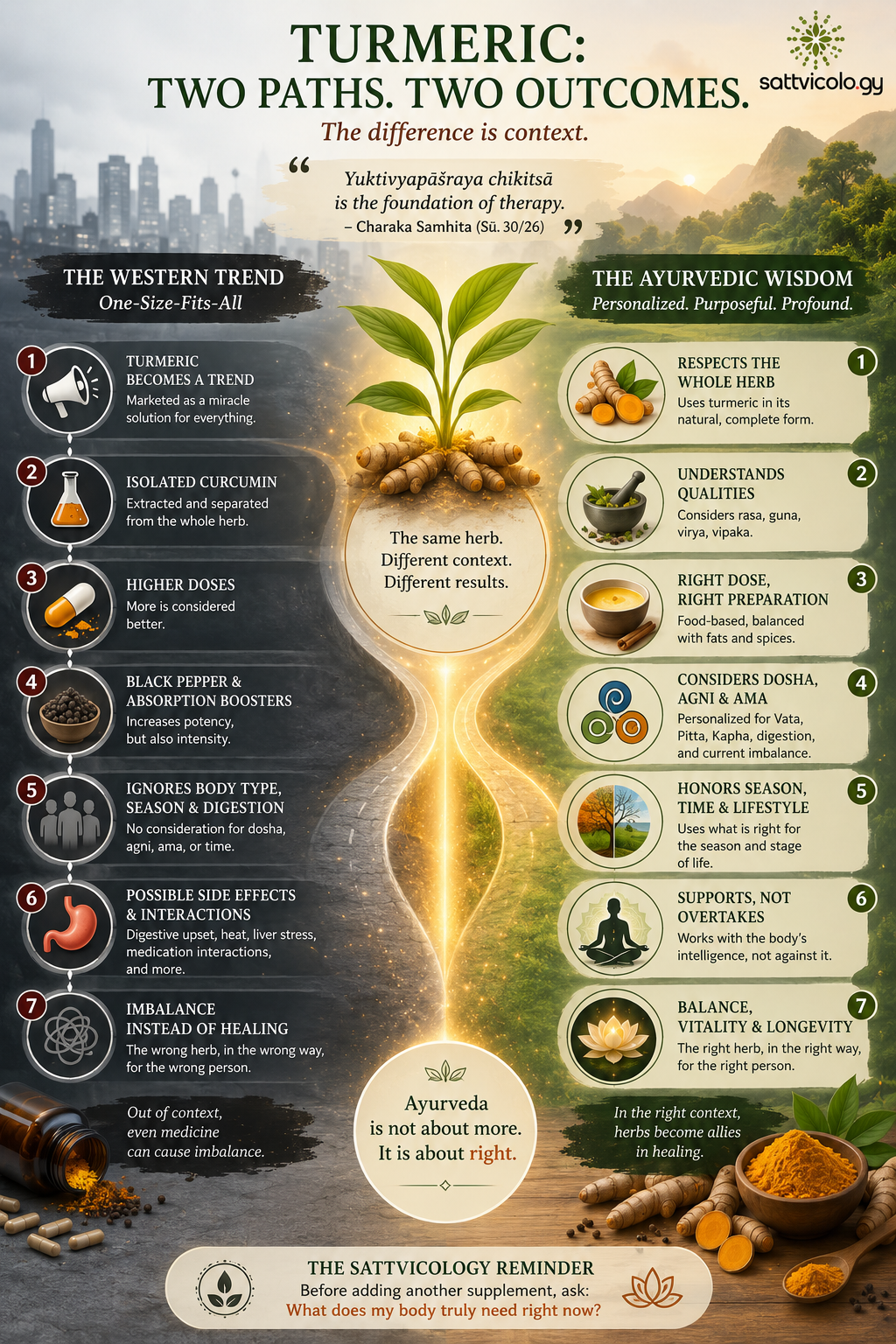
The Western Overhype: Why “Turmeric for Everyone” Is Not Ayurveda
The West often turns herbs into trends. Turmeric is a perfect example. The problem is not that turmeric is useless. The problem is that turmeric is frequently marketed without context.
Ayurveda does not practice universalism. It practices individualization. Turmeric may be helpful for one person and aggravating for another. It may be appropriate in winter but excessive in peak summer. It may be fine as a pinch in food but risky as a high-dose extract.
Ayurvedic Properties of Turmeric
| Ayurvedic Category | Turmeric / Haridra |
|---|---|
| Sanskrit name | Haridra |
| Botanical name | Curcuma longa |
| Taste / Rasa | Bitter, pungent |
| Potency / Virya | Hot |
| Post-digestive effect / Vipaka | Pungent |
| Qualities / Guna | Light, rough |
| Traditional actions | Kapha-balancing, scraping, cleansing, skin-supportive, digestive-supportive |
Turmeric by Body Type: Vata, Pitta, and Kapha
Ayurveda teaches that each person has a unique constitution, or prakriti, and a current state of imbalance, or vikriti. Turmeric should be evaluated against both.
Turmeric for Vata Dosha
Vata qualities: dry, light, cold, mobile, rough, subtle, irregular. Turmeric can help Vata when digestion is cold and sluggish or when there is ama without strong dryness. It can aggravate Vata when there is dryness, constipation, cracking joints, anxiety, insomnia, depletion, or underweight exhaustion.
Best way for Vata: Use small culinary amounts cooked into soups, kitchari, dals, stews, or warm milk with ghee. Avoid aggressive turmeric shots, high-dose extracts, and dry capsules unless guided by a practitioner.
Turmeric for Pitta Dosha
Pitta qualities: hot, sharp, oily, light, spreading, intense. Turmeric has hot potency and pungent post-digestive effect, so Pitta types need caution when they already have acidity, burning, rashes, anger, irritability, loose stools, ulcers, or inflammatory heat.
Best way for Pitta: Use turmeric sparingly. Pair it with cooling foods such as coconut, cilantro, fennel, coriander, or cooked greens. Avoid high-dose extracts unless supervised.
Turmeric for Kapha Dosha
Kapha qualities: heavy, cold, slow, oily, dense, stable, sticky. Kapha is often the dosha that benefits most from turmeric because turmeric’s bitter, pungent, hot, light, and rough qualities oppose Kapha heaviness, coldness, dampness, and sluggishness.
Best way for Kapha: Use turmeric in warm cooked meals, vegetable dishes, lentils, soups, and teas, especially in cold and damp seasons.
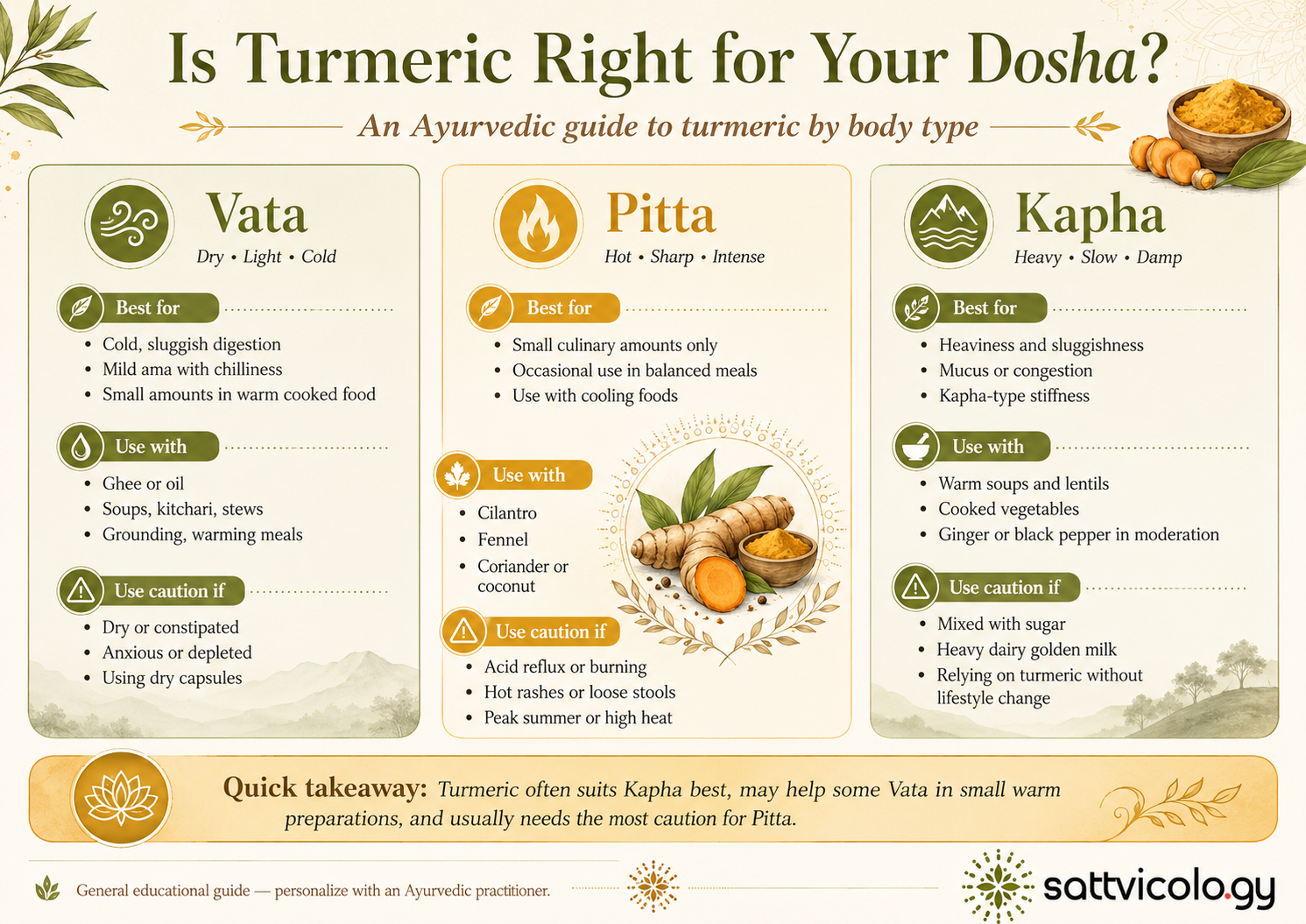
Best Months to Use Turmeric in the U.S. and Canada
Turmeric’s seasonal use should be guided by its Ayurvedic qualities: hot, light, rough, bitter, and pungent. For many people, turmeric fits best from October through April, especially when weather is cold, damp, cloudy, or Kapha-promoting. From May through September, especially in hot regions or during heat waves, turmeric may need to be reduced, especially for Pitta-dominant people.
| Season | Months | Ayurvedic Pattern | Turmeric Guidance |
|---|---|---|---|
| Late Fall | Oct–Nov | Vata rising, cooler/drier | Use small amounts with ghee/oil; avoid over-drying |
| Winter | Dec–Feb | Cold, heavy, slower digestion | Often beneficial, especially for Kapha |
| Early Spring | Mar–Apr | Kapha melting, mucus/congestion | One of the best seasons for turmeric |
| Late Spring | May | Kapha to Pitta transition | Moderate use |
| Summer | Jun–Aug | Pitta heat rises | Use cautiously, especially for Pitta |
| Early Fall | Sep | Dryness and Vata begin | Use gently with nourishing foods |
Side Effects of Turmeric
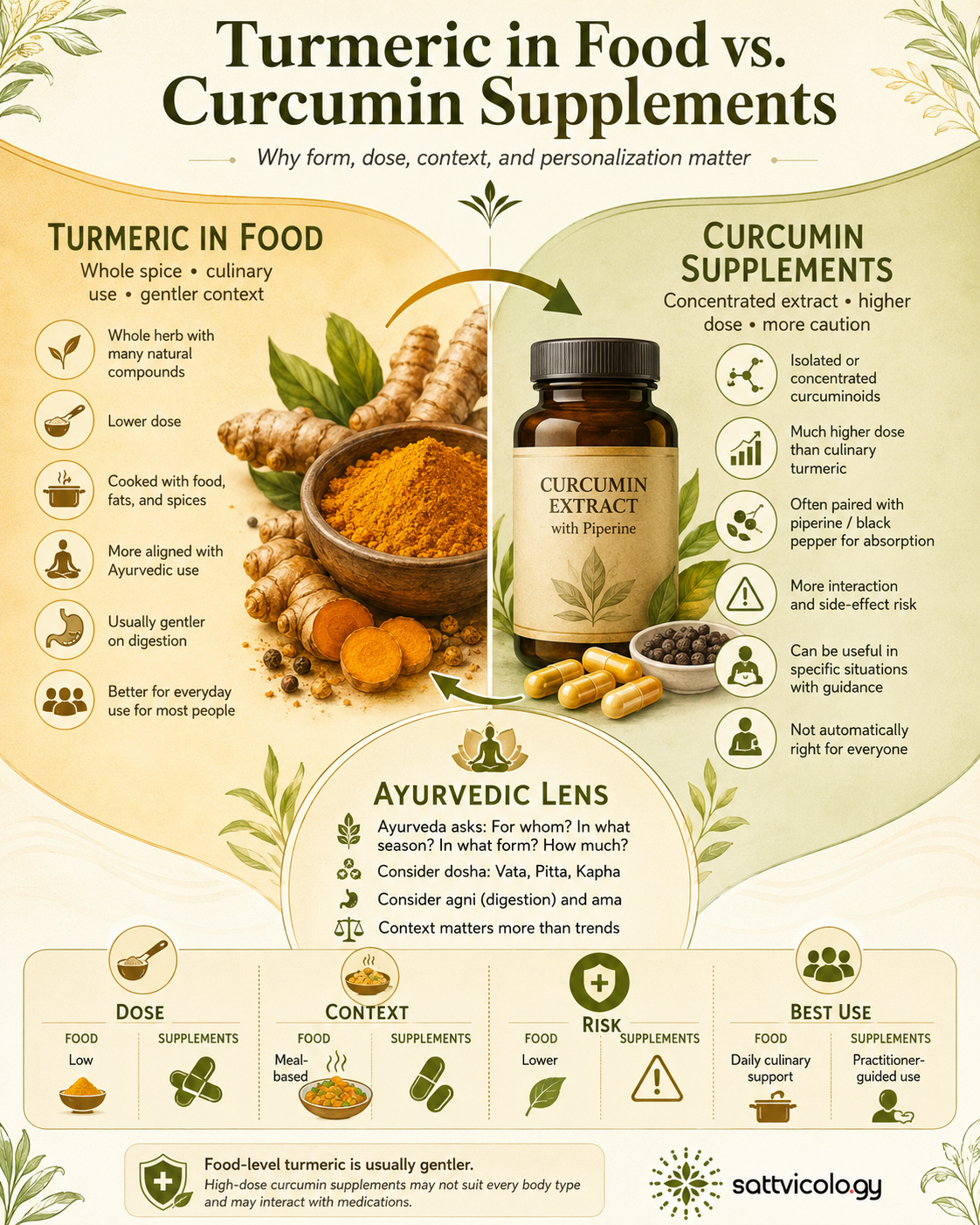
Turmeric in food is generally well tolerated for most people. The side effect conversation becomes more serious when turmeric is taken as a supplement, extract, high-dose curcumin product, or high-bioavailability formula with black pepper extract.
Possible side effects include: nausea, vomiting, acid reflux, stomach upset, diarrhea, constipation, skin itching, hives, worsened Pitta heat, dryness or constipation in Vata types, possible increased bleeding risk with anticoagulants, and rare liver injury from some high-bioavailability supplement formulations.
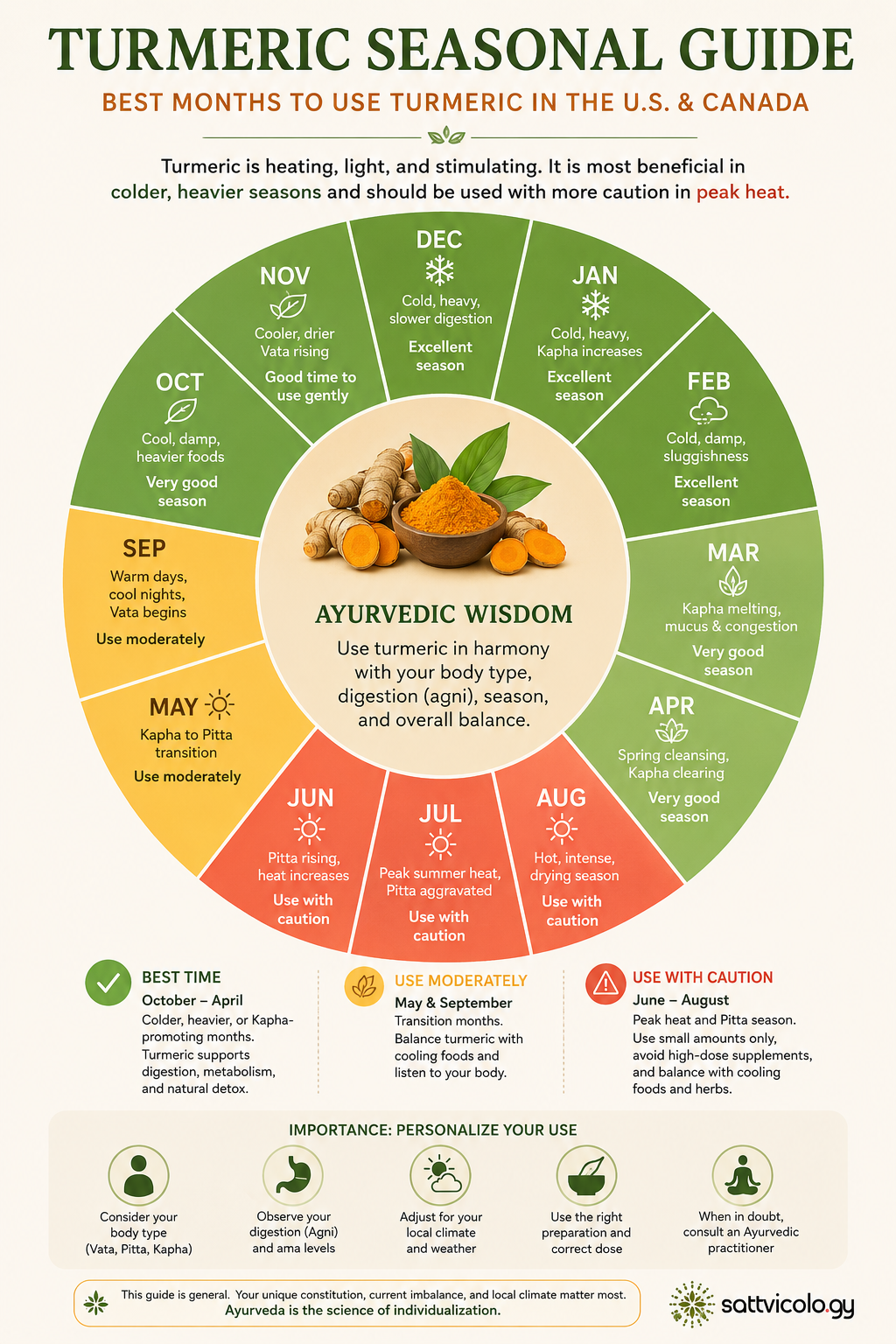
This is one of the most important parts of the turmeric conversation. A pinch of turmeric in dal is not the same as a concentrated curcumin capsule. But high-bioavailability forms of purified curcumin, including formulas using piperine from black pepper or other delivery technologies, have been linked to cases of liver injury.
Stop turmeric or curcumin products and seek medical care if you notice: unusual fatigue, nausea, poor appetite, dark urine, yellowing of the skin or eyes, right upper abdominal pain, or new itching with jaundice-like symptoms.
Turmeric and Medication Interactions
People taking prescription medications should speak with a qualified healthcare professional before using turmeric supplements. Use special caution with blood thinners, antiplatelet medications, chemotherapy drugs, tacrolimus, diabetes medications, acid reflux medications, liver-impacting medications, or multiple supplements with black pepper extract.
Food Turmeric vs. Curcumin Supplements
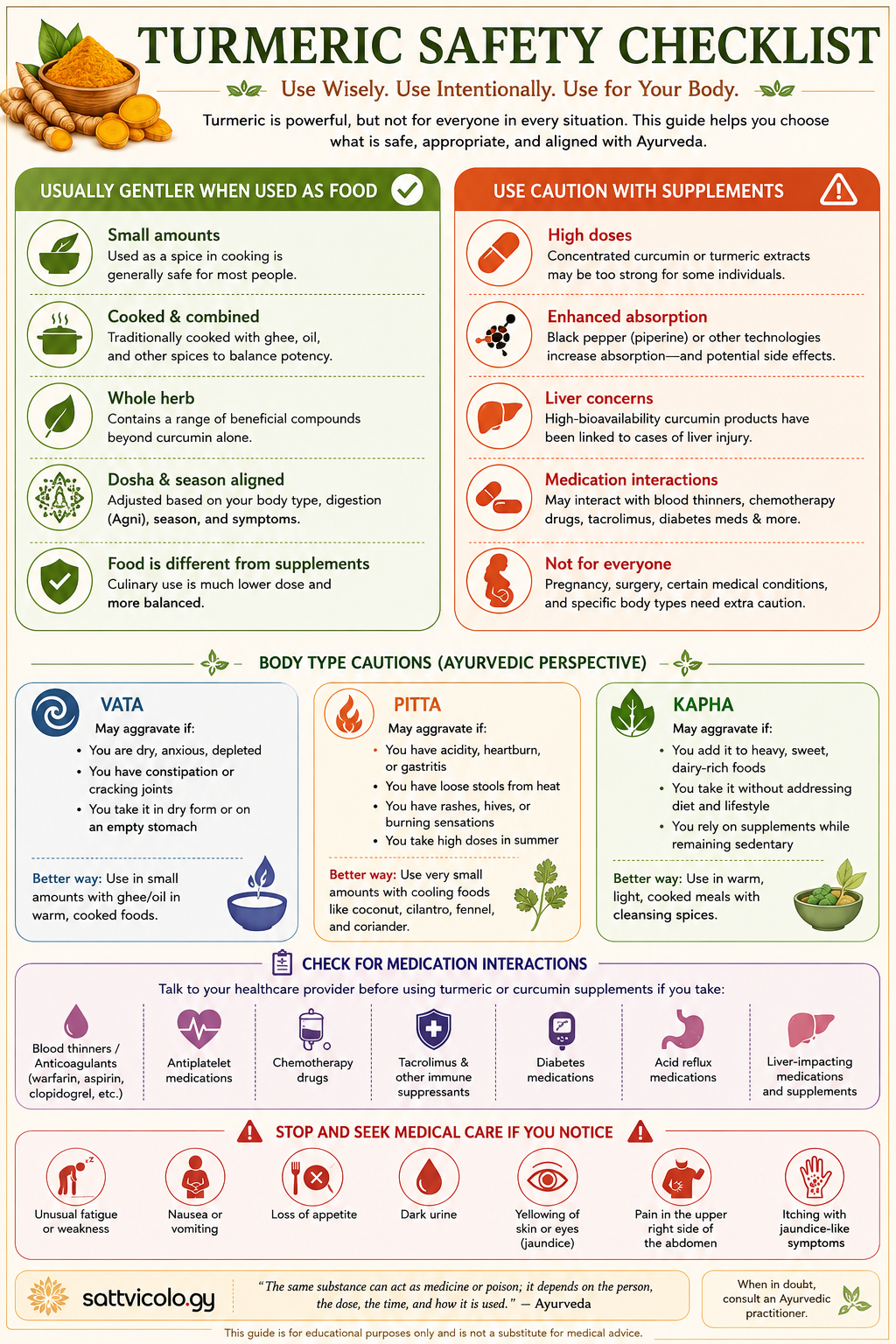
Turmeric in food is usually whole spice, lower dose, traditionally cooked, often combined with fats and other spices, and more aligned with Ayurvedic culinary use. Curcumin supplements are concentrated extracts, higher dose, often isolated curcuminoids, sometimes combined with piperine, and more likely to create interactions or side effects.
Ayurveda would say: potency without context can become imbalance.
How to Use Turmeric More Wisely
Use turmeric as food first. For most people, the safest starting point is turmeric in cooked meals, not capsules. Try kitchari, dal, lentil soup, vegetable curry, sautéed greens, rice dishes, warm milk with a small pinch of turmeric, and broths with cumin, coriander, and fennel.
Match turmeric to your dosha: Vata should use small amounts with ghee or oil; Pitta should use small amounts and avoid excess; Kapha often tolerates turmeric best, especially in winter and spring.
Avoid wellness stacking with black pepper extract, ginger, cayenne, apple cider vinegar, fasting, coffee, detox teas, liver cleanses, and multiple anti-inflammatory supplements unless guided by a practitioner.
Ayurvedic Recipes: Gentle Ways to Use Turmeric
Vata-Friendly Turmeric Ghee Rice: rice, ghee, small pinch turmeric, cumin, mineral salt, and cooked vegetables. This preparation helps soften turmeric’s drying quality.
Pitta-Friendly Cooling Turmeric Greens: cooked greens, small pinch turmeric, coriander, fennel, coconut, and cilantro. Avoid cayenne, excess ginger, and too much black pepper.
Kapha-Friendly Turmeric Lentil Soup: lentils, turmeric, ginger, black pepper in moderation, cumin, mustard seed, and greens. Avoid heavy cream, sugar, and excess dairy.
The Sattvicology View: Turmeric Is Sacred, Not Trendy
Turmeric deserves respect. It is not just a yellow powder. It is a traditional herb, food, ritual substance, skin remedy, and symbol of purification. But respect also means restraint.
The West has overhyped turmeric by reducing it to a supplement trend. Ayurveda restores the full intelligence around the herb: constitution, digestion, dose, season, preparation, and purpose.
Before asking, “What herb should I take?” ask: “What is my body asking for right now?”
FAQ: Turmeric, Ayurveda, Body Types, and Side Effects
Disclaimer
This article is for educational purposes only and is not medical advice. Turmeric and curcumin supplements may interact with medications and may not be appropriate for everyone. Consult a qualified healthcare provider and Ayurvedic practitioner before using turmeric therapeutically, especially if you are pregnant, breastfeeding, taking medications, preparing for surgery, undergoing cancer treatment, or managing liver, gallbladder, bleeding, digestive, or chronic inflammatory conditions.
