Sahacharadi Taila (सहचरादि तैल): 9 Ayurvedic Benefits for Sciatica, Low Back Pain, Stiffness & Vata Disorders
A classical Ayurvedic medicated oil traditionally used for Vata-related lower-body pain, stiffness and Gridhrasi, explored here alongside modern clinical research and safety guidance.
When Pain Travels Downward: Ayurveda’s Sahacharadi Taila
There are pains that remain in one place—and then there are pains that seem to travel.
A tight lower back becomes an aching buttock. The discomfort moves through the thigh. A shooting or pulling sensation appears behind the knee or calf. Walking feels different. Sitting becomes uncomfortable. Sleep may be disturbed simply because the body cannot find a position of ease.
Ayurveda has described a remarkably similar pattern for centuries.
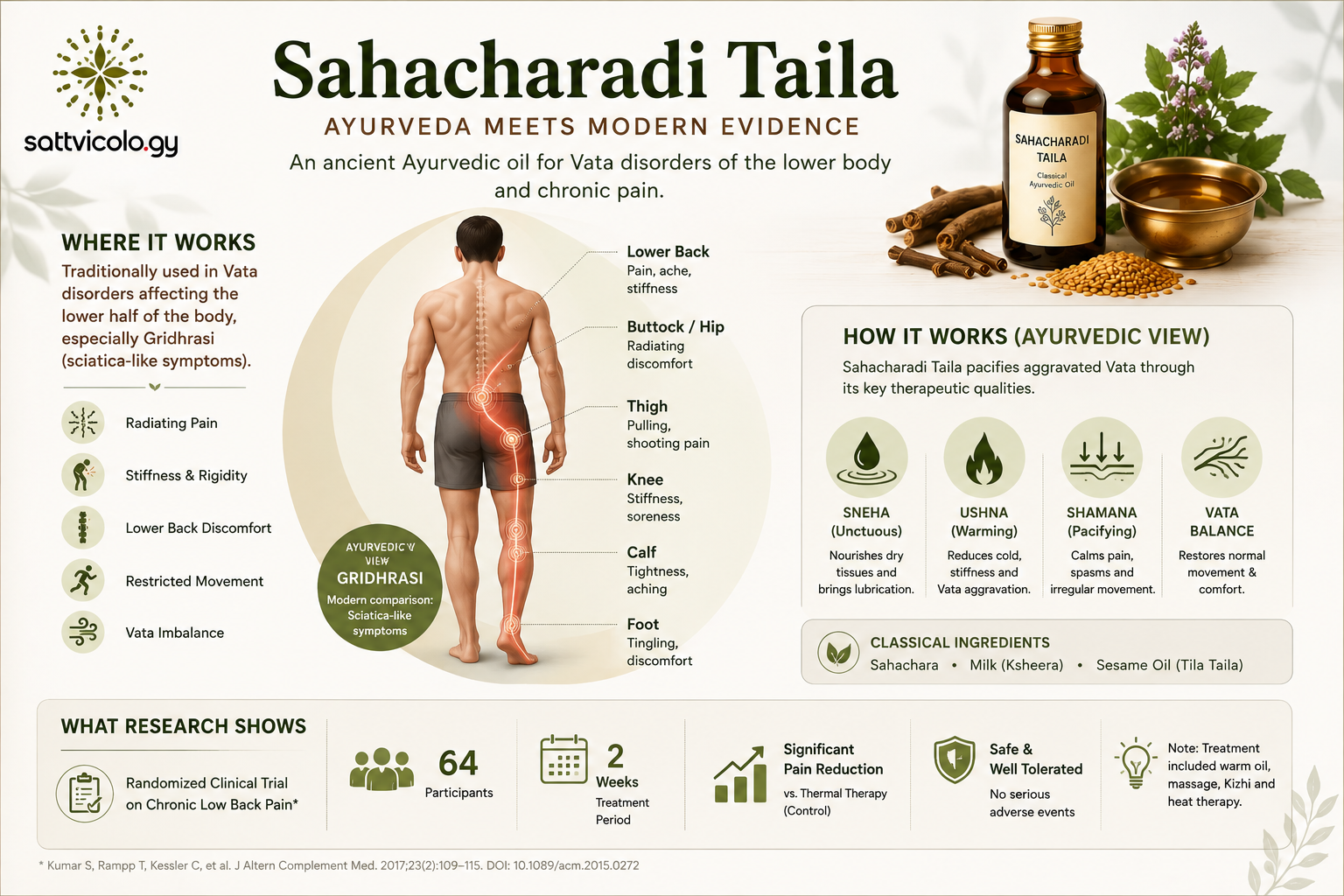
The classical condition Gridhrasi (गृध्रसी) is characterized by pain, stiffness and piercing sensations that can begin around the buttocks and lower back and extend downward through the thigh, knee, calf and foot.
Today, Gridhrasi is frequently discussed alongside the modern clinical presentation of sciatica, although the two diagnostic systems should not be considered literally identical.
One traditional preparation used when this downward-moving pattern reflects aggravated Vata dosha is Sahacharadi Taila (सहचरादि तैल)—a classical medicated Ayurvedic oil especially associated with the lower half of the body.
And unlike many Ayurvedic preparations for which modern research remains almost entirely traditional or observational, Sahacharadi Taila has been used in a randomized controlled clinical trial involving chronic low back pain.
What Is Sahacharadi Taila?
Sahacharadi Taila, also written Sahacharadi Tailam, is a classical Ayurvedic medicated oil formulated primarily for disorders associated with aggravated Vata, especially conditions involving pain, stiffness, impaired movement and the lower body.
The name comes from Sahachara, the principal herb traditionally used in the preparation.
A classical formulation cited in Ashtanga Hridaya contains:
- Sahachara
- Ksheera — milk
- Tila Taila — sesame oil
A 2020 clinical paper discussing the classical formulation cites Ashtanga Hridaya, Chikitsa Sthana, Vatavyadhi Chikitsa, Chapter 21, verses 70–72, and describes the oil as possessing Ushna, or warming qualities, traditionally used to pacify aggravated Vata and Kapha and particularly associated with disorders affecting the lower half of the body.
Commercial preparations may differ depending on the classical reference, manufacturer and regional Ayurvedic tradition, so ingredient labels should always be checked.
The Ayurvedic Logic Behind Sahacharadi Taila
Ayurveda associates Vata dosha with movement.
Vata governs concepts such as nerve impulses, bodily movement, locomotion, muscular coordination, elimination, flexibility and sensory activity.
When Vata becomes disturbed, classical descriptions often include qualities such as Ruksha (dry), Sheeta (cold), Chala (mobile), Khara (rough) and Laghu (light).
A Vata-associated musculoskeletal presentation may therefore involve wandering or radiating discomfort, stiffness, dryness, cracking joints, restricted movement, spasmodic discomfort, sensitivity to cold, weakness or instability.
Ayurvedic oil therapy uses the principle of treating excessive dryness and irregular movement with Sneha—unctuousness and nourishment.
Sahacharadi Taila is traditionally considered especially relevant when Vata affects Adho Kaya, or the lower region of the body.
The Ayurvedic Logic Behind Sahacharadi Taila
It is important to distinguish between traditional Ayurvedic indications and conditions for which Sahacharadi Taila has been validated through modern clinical trials.
Current human research is promising but limited.
1. Chronic Lower Back Pain
This is where Sahacharadi Taila has some of its strongest modern clinical evidence.
A randomized controlled trial published in The Journal of Alternative and Complementary Medicine enrolled 64 adults with chronic nonspecific low back pain.
Participants were randomized to either six Ayurvedic external therapy sessions over two weeks using warm Sahacharadi Taila, massage and Kizhi treatment, or standard local thermal therapy with mild massage.
After two weeks, mean pain scores in the Ayurvedic treatment group decreased from approximately 53.4 to 21.6 on a 100-mm visual analog scale, compared with a reduction from approximately 55.3 to 41.8 in the control group.
The between-group difference was statistically significant.
The researchers concluded that the Ayurvedic external treatment produced meaningful short-term pain relief, although it did not significantly improve disability or functional impairment during the short observation period. No serious adverse events were reported.
What this means: The study provides encouraging evidence for a treatment protocol incorporating Sahacharadi Taila, but it does not prove that the oil alone produced the effect because massage, warmth and other elements were administered simultaneously.
2. Sciatica-Like Pain and Gridhrasi
One of Sahacharadi Taila’s best-known traditional indications is Gridhrasi.
Classical descriptions include Ruk (pain), Toda (piercing or pricking pain) and Stambha (stiffness), with discomfort extending from the buttock and lumbar area into the thigh, knee, calf and foot.
These symptoms overlap substantially with common descriptions of sciatic nerve pain.
A 2020 comparative clinical study examined 40 patients with Gridhrasi/sciatica, randomized into two groups receiving either Vyoshadi Taila or Sahacharadi Taila through a therapeutic Ayurvedic Matra Basti protocol, together with local oil massage and steam therapy.
The Sahacharadi group demonstrated improvement in several measures including radiating pain, stiffness, pricking sensations, straight-leg-raise testing and lumbar movement.
The authors calculated an overall improvement of approximately 40.49% in the Sahacharadi group, although the comparison oil performed better overall.
This study was small and used multiple Ayurvedic procedures, so it should be considered preliminary evidence rather than definitive proof of efficacy.
3. Stiffness of the Lower Back and Legs
Ayurveda often interprets persistent stiffness as involving disturbed Vata, sometimes combined with Kapha.
Sahacharadi Taila’s traditional warming and unctuous qualities make it particularly suited to Ayurvedic external therapies where stiffness improves with warmth.
The 2020 Gridhrasi study reported statistically significant improvements in Stambha—stiffness within the Sahacharadi treatment group.
This does not establish Sahacharadi Taila as a treatment for every cause of stiffness. Persistent stiffness accompanied by weakness, numbness, swelling, fever or progressive symptoms requires medical evaluation.
4. Radiating Leg Discomfort
Radiating discomfort is one of the characteristics that makes Sahacharadi Taila particularly interesting within Ayurvedic medicine.
Rather than being regarded simply as a generalized massage oil, it is traditionally associated with Vata-related lower-body disorders.
The classical Gridhrasi pattern describes pain traveling along:
- lower back
- buttock
- thigh
- knee
- calf
- foot
That distribution resembles the typical route people describe when talking about irritation involving the sciatic nerve.
Modern research has not established Sahacharadi Taila as a treatment for nerve compression itself. Structural conditions such as a significant herniated disc, spinal stenosis or progressive neurologic impairment require conventional evaluation.
5. Limited Mobility Associated With Pain
Pain and stiffness frequently restrict movement.
The Sahacharadi clinical study in Gridhrasi evaluated lumbar movement and straight-leg-raising tests and observed improvements in several mobility-related parameters.
The stronger randomized chronic low-back-pain trial, however, found that although pain improved significantly, functional disability did not improve significantly within the short study period.
Reduced pain does not necessarily mean that the underlying condition has resolved or that strength, biomechanics or mobility have returned to normal.
6. Muscular Tension Around the Lumbar and Gluteal Region
Warm oil massage is widely incorporated into Ayurvedic treatment for areas that feel cold, contracted or tense.
In the randomized clinical trial, therapists applied warm Sahacharadi Taila using light manual pressure to the lower back, gluteal region and painful areas.
The protocol also incorporated warmed herbal cotton bags known as Kizhi.
Massage itself can influence pain perception through sensory and neurophysiological mechanisms, and the researchers explicitly noted that the treatment effect was likely multimodal rather than attributable solely to the herbal oil.
7. Vata-Associated Lower-Body Disorders
In classical Ayurvedic language, Sahacharadi Taila is particularly connected with Adho Kaya Vata Roga—Vata disorders affecting the lower region of the body.
This concept may include patterns involving the lower back, hips, buttocks, thighs, knees, calves, legs and feet.
This is an Ayurvedic classification and should not be confused with a modern biomedical diagnosis.
8. Joint Discomfort and Degenerative Patterns
Sahacharadi Taila also appears in smaller Ayurvedic studies involving Sandhigata Vata, a traditional condition commonly compared with osteoarthritis.
Published research has evaluated Sahacharadi Taila in combination with other Ayurvedic interventions for knee osteoarthritis, but these studies are generally small and methodologically weaker than the randomized chronic low-back-pain trial.
For that reason, it is more accurate to say: Sahacharadi Taila is traditionally used for joint discomfort and stiffness, while modern evidence for osteoarthritis specifically remains preliminary.
It should not be presented as a proven treatment for cartilage degeneration.
9. Supporting Comfort During Ayurvedic Abhyanga
Abhyanga means therapeutic oil application or massage.
Ayurveda traditionally values Abhyanga especially when Vata qualities become excessive.
Warm Sahacharadi Taila may be selected by an Ayurvedic practitioner when the predominant presentation includes coldness, stiffness, pain, dryness, tension, restricted movement and lower-body Vata disturbance.
The therapeutic goal is traditionally described as restoring Sneha—unctuousness, grounding and nourishment—to tissues dominated by excessive dryness and irregular movement.
What Does Modern Research Actually Say?
This question deserves a direct answer.
The strongest published trial: Kumar S, Rampp T, Kessler C, et al. conducted a randomized controlled clinical trial of Ayurvedic external therapy incorporating Sahacharadi Taila in chronic nonspecific low back pain.
- Participants: 64
- Treatment period: 2 weeks
- Ayurvedic treatments: 6 sessions
- Follow-up: 4 weeks total
- Primary outcome: Pain measured using a visual analog scale
At week two, pain declined substantially more in the Ayurvedic treatment group than in the thermal-therapy comparison group.
The group difference was approximately 18.7 points on the 100-mm pain scale, with a 95% confidence interval of approximately 8.7 to 28.7 points in favor of Ayurvedic therapy, and p < 0.001.
Researchers also reported improvements in pain-related bothersomeness, fatigue, vitality and some psychological outcomes. However, functional disability did not significantly improve.
The study lasted only four weeks, so it cannot determine long-term effectiveness.
The evidence should not be overstated: the intervention consisted of more than Sahacharadi Taila. Participants also received massage, Kizhi therapy, warmth and structured rest. Therefore, the trial supports the combined Ayurvedic external treatment protocol—not the oil in isolation.
Sahacharadi Taila and Sciatica: Can It Cure Sciatica?
No clinical evidence currently establishes Sahacharadi Taila as a cure for sciatica.
Sciatica is a symptom pattern rather than a single disease. It can occur when the sciatic nerve or associated spinal nerve roots become irritated or compressed.
Possible causes include lumbar disc herniation, spinal stenosis, degenerative changes, spondylolisthesis, trauma and other spinal or neurologic disorders.
Sahacharadi Taila may be used in Ayurvedic supportive care for Gridhrasi-like patterns, and preliminary clinical research suggests potential benefits for pain and stiffness.
But an oil cannot be assumed to reverse a structural disc problem or relieve serious nerve compression.
How Is Sahacharadi Taila Traditionally Used?
Depending on the person’s constitution and condition, an Ayurvedic practitioner may incorporate Sahacharadi Taila through therapies such as:
Abhyanga
Warm oil massage applied to areas such as the lower back, hips or legs.
Kati Basti
A traditional localized treatment in which warm medicated oil is retained over the lumbar region within a temporary dough boundary.
Pizhichil or Oil-Based Therapies
Warm medicated oil may be incorporated into specialized Ayurvedic therapeutic procedures.
Matra Basti
Medicated oil may sometimes be administered rectally as part of Panchakarma therapy.
Matra Basti should only be performed under qualified Ayurvedic clinical supervision. It is not a home treatment.
Simple Home Application for Massage
For uncomplicated muscular stiffness, a practitioner may sometimes recommend Sahacharadi Taila as an external massage oil.
- Warm a small amount of the oil indirectly.
- Test the temperature carefully.
- Apply gently over the intended area.
- Massage with comfortable, unforced strokes.
- Allow the oil to remain briefly if appropriate.
- Follow with warmth or a warm shower if advised.
This should not be used as a substitute for medical evaluation when significant neurologic symptoms are present.
Who May Benefit Most From Sahacharadi Taila in Ayurvedic Practice?
From an Ayurvedic perspective, Sahacharadi Taila is more likely to be considered when discomfort exhibits qualities associated with aggravated Vata, such as pain that feels cold, stiffness, dryness, cracking, variable symptoms, radiating sensations, increased discomfort in cold weather, improvement with warmth, tightness after inactivity and lower-body predominance.
An Ayurvedic practitioner would also evaluate Prakriti, Vikriti, Agni, Ama, strength, age, season and the underlying disease process before selecting a treatment.
When Sahacharadi Taila Is Not Enough
A person should seek medical assessment rather than relying solely on massage oil when back or leg pain is accompanied by:
- progressive weakness
- loss of bladder or bowel control
- numbness in the saddle region
- severe trauma
- fever
- unexplained weight loss
- history of cancer
- severe nighttime pain
- progressive numbness
- inability to walk normally
- sudden severe symptoms
These can indicate conditions requiring urgent evaluation.
Is Sahacharadi Taila Safe?
In the 64-patient randomized chronic low-back-pain trial, the Ayurvedic external therapy was described as safe and well tolerated, with no serious adverse events reported.
However, individual products and individuals differ.
- Perform a small skin patch test.
- Avoid broken or infected skin unless professionally directed.
- Stop use if irritation develops.
- Confirm ingredients in case of allergies.
- Consult a qualified professional during pregnancy.
- Obtain medical advice when treating chronic neurologic or musculoskeletal disease.
Internal use, therapeutic Basti and intensive Ayurvedic procedures require professional supervision.
Sahacharadi Taila vs. Ordinary Sesame Oil
Sesame oil itself has an important place in Ayurveda, particularly for Vata-pacifying massage.
Sahacharadi Taila is different because the sesame oil is used as a Sneha base for processing medicinal botanicals and other classical ingredients.
Ayurveda calls this process Sneha Paka.
The objective is not simply to create scented massage oil. It is to transform the lipid medium into a classical herbal preparation capable of carrying qualities of the medicinal ingredients used during preparation.
Why Sahacharadi Taila Remains Relevant Today
Modern lifestyles generate an unusual paradox.
We move less—but our nervous systems rarely stop moving.
Hours of sitting, driving, screen use and reduced physical activity can coexist with chronic muscular tension, poor posture, shortened hip musculature, sedentary behavior, stress, disrupted sleep and limited mobility.
Ayurveda would not attribute every modern back disorder to one dosha or recommend one oil for every person.
Yet the ancient principle behind Sahacharadi Taila remains compelling:
When movement becomes painful, irregular, cold and restricted, therapy may begin by restoring warmth, lubrication, softness and mindful movement.
The Sattvic Perspective
Ayurveda does not ask us merely, “Where does it hurt?”
It asks: What quality has entered the body?
Is there excessive cold? Dryness? Restriction? Instability? Heaviness? Inflammation? Weakness?
Pain is a message—but Ayurveda seeks to understand the language in which that message is being spoken.
Sahacharadi Taila represents one response to a distinctly Vata-like language of discomfort: movement that has become painful, dry, restricted or irregular.
Modern medicine gives us indispensable tools for identifying structural disease, neurologic compromise and dangerous causes of back pain.
Ayurveda adds another layer: attention to warmth, touch, movement, constitution, routine and the qualities through which imbalance expresses itself.
The most intelligent approach does not require choosing one system against another. It requires knowing what each system can—and cannot—tell us.
Clinical & Scholarly Sources
Kumar S, Rampp T, Kessler C, et al. Effectiveness of Ayurvedic Massage (Sahacharadi Taila) in Patients with Chronic Low Back Pain: A Randomized Controlled Trial. Journal of Alternative and Complementary Medicine. 2017;23(2):109–115. DOI: 10.1089/acm.2015.0272. The trial included 64 patients and found significantly greater short-term pain reduction in the Ayurvedic treatment group.
Vasudev R, Deshpande SS. A Comparative Clinical Study on Matra Basti with Sahacharadi Taila and Vyosadi Taila in Gridhrasi W.S.R. to Sciatica. International Ayurvedic Medical Journal. 2020. DOI: 10.46607/iamj1908102020. This small comparative study included 40 patients and reported improvements in several sciatica/Gridhrasi parameters in the Sahacharadi group.
Classical reference cited within the clinical literature: Ashtanga Hridaya, Chikitsa Sthana, Vatavyadhi Chikitsa, Chapter 21, verses 70–72.
Evidence Summary
Traditional evidence: Strong historical Ayurvedic use for Vata disorders, especially lower-body conditions and Gridhrasi.
Clinical evidence for chronic nonspecific low-back pain: Promising. One randomized controlled trial found significantly greater short-term pain reduction with an Ayurvedic external therapy protocol incorporating Sahacharadi Taila than with thermal therapy.
Clinical evidence for sciatica/Gridhrasi: Preliminary. Small Ayurvedic clinical studies report improvement in certain symptoms and physical measures.
Evidence for osteoarthritis: Preliminary and insufficient for definitive therapeutic claims.
Evidence that Sahacharadi Taila reverses structural spinal disease: Not established.
Frequently Asked Questions About Sahacharadi Taila
Sahacharadi Taila is a classical Ayurvedic medicated oil traditionally used for Vata-related disorders affecting the lower body, particularly pain, stiffness, reduced mobility, lower-back discomfort and Gridhrasi, an Ayurvedic condition commonly compared with sciatica.
Ayurveda traditionally uses Sahacharadi Taila in Gridhrasi-like conditions involving radiating pain from the buttock or lower back down the leg. Small clinical studies have reported improvements in some sciatica-related symptoms, but evidence remains preliminary. It should not be considered a proven cure for sciatic nerve compression.
There is no single best Ayurvedic oil for every case of sciatica. Sahacharadi Taila is one classical option frequently associated with Gridhrasi and lower-body Vata conditions. Selection depends on the individual’s symptoms, constitution and underlying cause.
A randomized controlled trial involving 64 adults found that an Ayurvedic external therapy protocol using Sahacharadi Taila produced significantly greater short-term reduction in chronic nonspecific lower-back pain than a thermal-therapy comparison treatment. Because the intervention also included massage and Kizhi, the oil’s independent effect cannot be determined.
No reliable clinical evidence shows that Sahacharadi Taila repairs a herniated or slipped disc. It may be incorporated into supportive Ayurvedic pain-management protocols, but structural spinal disease requires appropriate medical diagnosis.
Some Ayurvedic practitioners recommend regular external use for selected individuals, but frequency depends on constitution, symptoms, season, skin sensitivity and therapeutic goals. Persistent pain should be evaluated professionally.
Ayurvedic external therapies commonly use the oil comfortably warm, particularly for Vata-dominant stiffness and coldness. The oil should never be hot enough to burn or irritate the skin.
Sahacharadi Taila is traditionally used for Vata-associated joint pain and stiffness, and small studies have explored it in Ayurvedic protocols for knee osteoarthritis. Evidence is still insufficient to conclude that it treats osteoarthritis itself.
Traditional Ayurveda uses Sahacharadi Taila for certain radiating or Vata-associated pain patterns. Modern research has not established it as a general treatment for peripheral neuropathy or all forms of nerve pain.
Gridhrasi is an Ayurvedic Vata disorder traditionally characterized by pain, stiffness and pricking sensations that may extend from the buttock and lumbar area through the thigh, knee, calf and foot. Because this resembles modern sciatica, the two are frequently compared, although they arise from different medical frameworks.
Classical Ayurvedic descriptions primarily associate Sahacharadi Taila with calming aggravated Vata, with some references also describing Vata-Kapha balancing qualities.
Occasional external use on healthy skin may be appropriate for some people, but chronic back pain, radiating pain, numbness or weakness should be professionally evaluated. Panchakarma uses such as Matra Basti should not be attempted without trained clinical supervision.
Explore Your Ayurvedic Constitution
Sahacharadi Taila is traditionally selected according to the qualities of imbalance—not simply by symptom name. Understanding your constitution can help you explore Ayurveda more thoughtfully.
Medical Disclaimer
This article is intended for educational purposes and discusses traditional Ayurvedic practices alongside available scientific research. Sahacharadi Taila and Ayurvedic therapies should not be used to diagnose, treat, cure or prevent disease without appropriate professional guidance. Persistent back pain, radiating leg pain, numbness, weakness or changes in bladder or bowel function require evaluation by a qualified healthcare professional.