
Living with Chronic Pain? Ayurveda and Yoga Offer More Than Symptom Relief
Pain changes more than the body.
It changes how you sleep. It changes how you move. It changes relationships, work, confidence, emotions, and sometimes even your identity.
According to the Centers for Disease Control and Prevention (CDC), approximately one in five adults in the United States lives with chronic pain, making it one of the most common long-term health conditions in North America. Chronic pain contributes to disability, reduced quality of life, depression, anxiety, sleep disturbances, lost productivity, and significant healthcare costs.
Modern medicine has transformed the diagnosis and treatment of chronic pain through physical therapy, medications, interventional procedures, surgery when appropriate, behavioral therapies, and multidisciplinary rehabilitation. These approaches remain essential and should never be replaced without medical guidance.
Yet many people continue asking an important question:
“What else can I do to improve my quality of life?”
This is where Ayurveda and Yoga may provide meaningful support.
Rather than focusing only on pain itself, Ayurveda encourages practitioners to understand why the body has lost balance. It explores digestion, inflammation, sleep, emotional health, daily routines, nutrition, movement, stress, seasonal influences, and the relationship between the mind and body.
Yoga complements this perspective by encouraging gentle movement, improved breathing, nervous system regulation, mindfulness, and greater body awareness.
Together, these two ancient sciences do not promise to cure chronic pain. Instead, they offer practical lifestyle tools that may help people:
- Improve mobility
- Support healthy digestion
- Reduce stress
- Improve sleep quality
- Build resilience
- Enhance emotional wellbeing
- Improve overall quality of life
This article explores how classical Ayurvedic wisdom and modern scientific understanding can work together to support individuals living with chronic pain.
Ancient Wisdom Meets Modern Pain Science
More than 2,000 years ago, Ayurvedic physicians recognized that pain rarely exists in isolation.
The Charaka Samhita, one of Ayurveda‘s foundational texts, emphasizes understanding the whole person, including digestion, nutrition, mental state, constitution (Prakriti), environment, and daily habits before attempting to restore health.
One frequently cited Ayurvedic principle is:
“When digestion is balanced, health flourishes. When digestion is disturbed, disease begins.”
Charaka Samhita, Sutrasthana — paraphrased concept emphasizing Agni as the foundation of health.
Although modern medicine uses different terminology, contemporary research increasingly recognizes the interconnected roles of inflammation, the gut microbiome, sleep quality, psychological stress, physical activity, and nervous system regulation in persistent pain.
Today, many integrative medicine programs combine evidence-based conventional care with nutrition, exercise, mindfulness, yoga, and complementary therapies—reflecting a growing appreciation for whole-person care.
What Is Chronic Pain?
Pain is the body’s natural alarm system.
When you touch a hot surface or sprain an ankle, pain serves a protective purpose. It encourages rest and healing while damaged tissues recover.
Most acute pain gradually improves as healing occurs.
Chronic pain is different.
The International Association for the Study of Pain (IASP) generally defines chronic pain as pain that persists or recurs for longer than three months.
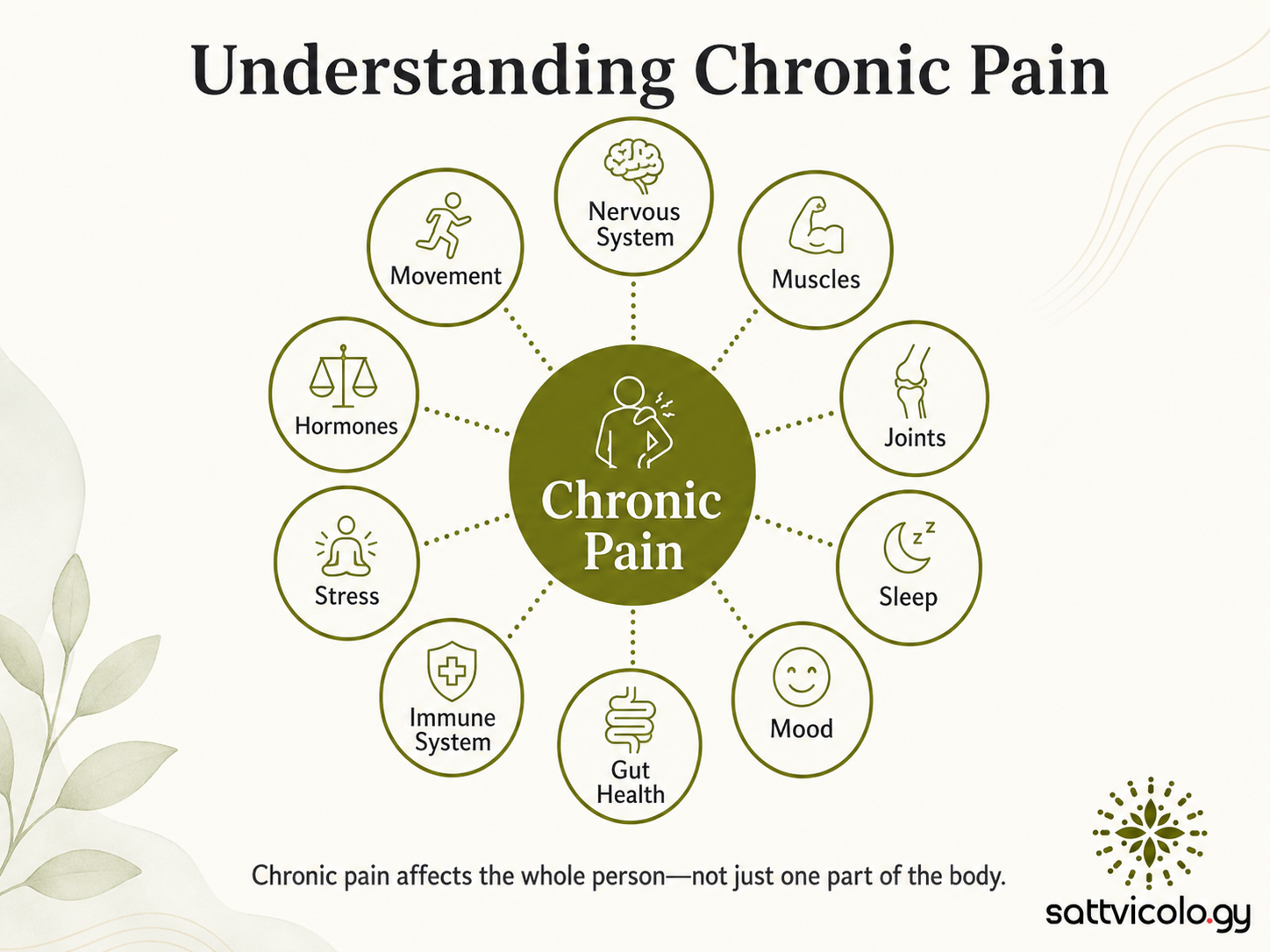
It may continue even after tissues have healed, and it often involves complex interactions among the nervous system, immune system, brain, emotions, sleep, movement, and overall health.
Common chronic pain conditions include:
- Osteoarthritis
- Rheumatoid arthritis
- Fibromyalgia
- Chronic low back pain
- Neck pain
- Migraine
- Neuropathic pain
- Sciatica
- Temporomandibular joint (TMJ) disorders
- Chronic pelvic pain
- Persistent post-surgical pain
Pain may also accompany conditions such as multiple sclerosis, Parkinson’s disease, cancer, inflammatory bowel disease, lupus, and diabetes.
Acute Pain vs. Chronic Pain
| Acute Pain | Chronic Pain |
|---|---|
| Short-term | Lasts longer than three months |
| Usually linked to injury | May persist after tissues heal |
| Protective | Often involves nervous system sensitization |
| Improves as healing occurs | Can fluctuate for months or years |
| Helps prevent further injury | May affect mood, sleep, relationships, and daily function |
Understanding this distinction helps explain why treating chronic pain often requires a broader strategy than simply treating an injury.
How Modern Medicine Understands Chronic Pain
Medical science now recognizes that persistent pain involves far more than injured tissues. Researchers describe chronic pain as a condition influenced by multiple interconnected systems.
The Nervous System
Pain signals travel through nerves to the spinal cord and brain.
Over time, these pathways can become more sensitive—a process called central sensitization—causing ordinary sensations to feel painful or amplifying existing pain.
Inflammation
Inflammation is an important part of healing, but when it becomes persistent or dysregulated, it may contribute to ongoing discomfort in some conditions.
Sleep
Poor sleep increases pain sensitivity.
Pain also disrupts sleep, creating a cycle that becomes increasingly difficult to break.
Mental Health
Depression, anxiety, fear of movement, chronic stress, and emotional trauma can influence how pain is experienced.
This does not mean pain is “all in your head.” Rather, it reflects the close relationship between the brain, nervous system, and body.
Physical Activity
Avoiding movement because of pain may gradually weaken muscles, reduce flexibility, and contribute to even greater discomfort.
Appropriately guided movement is often an important part of rehabilitation.
Nutrition
Diet influences overall health and, in some cases, inflammatory processes, body weight, gut health, and metabolic function.
Although no single diet cures chronic pain, healthy eating patterns may support overall wellbeing.
How Ayurveda Understands Pain
Ayurveda approaches pain from a different—but often complementary—perspective.
Instead of asking only:
“Where does it hurt?”
Ayurveda also asks:
- What is your constitution?
- What has changed?
- How is digestion?
- How are you sleeping?
- How are you managing stress?
- Are toxins (Ama) accumulating?
- Which Doshas are disturbed?
- How is your daily routine?
- What season is it?
- What is your emotional state?
Rather than focusing solely on the painful body part, Ayurveda seeks to restore balance throughout the entire system.
Vata: The Dosha Most Commonly Associated with Pain
Among the three Doshas—Vata, Pitta, and Kapha—Ayurveda most often associates pain with Vata.
Vata governs:
- Movement
- Nerve impulses
- Circulation
- Breathing
- Communication between tissues
- Flexibility
- Creativity
When balanced, Vata supports graceful movement, adaptability, and healthy nervous system function.
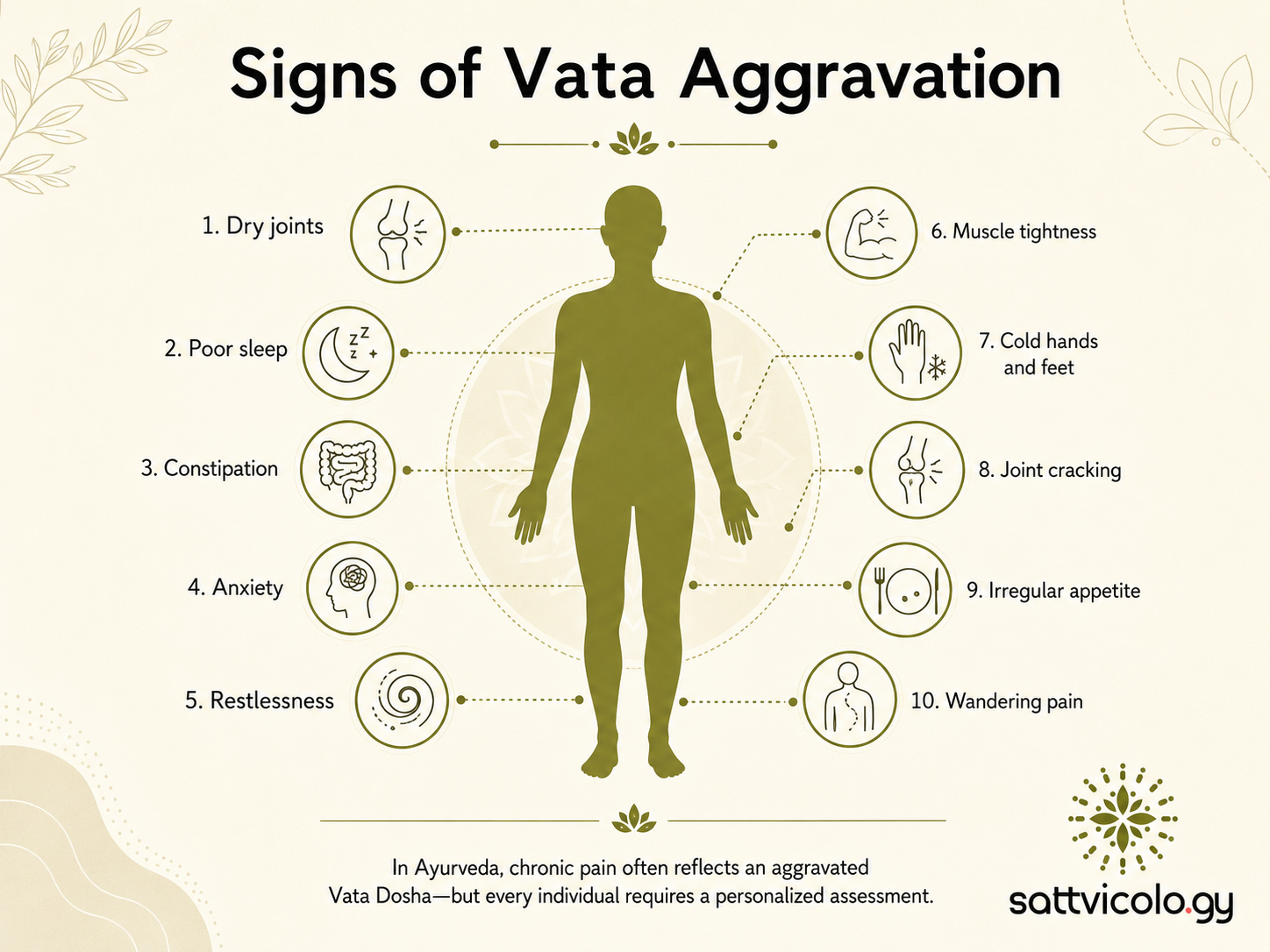
When aggravated, classical Ayurvedic texts describe symptoms that may include:
- Dryness
- Stiffness
- Cracking joints
- Muscle tension
- Wandering pain
- Shooting pain
- Tingling sensations
- Anxiety
- Insomnia
- Constipation
- Restlessness
Many people with persistent musculoskeletal pain recognize several of these patterns.
This does not mean every person with chronic pain has a Vata imbalance, but Vata often becomes an important consideration during Ayurvedic assessment.
Agni: Why Digestion Matters in Chronic Pain
One of Ayurveda’s most profound teachings is that health begins with Agni, the digestive fire.
Agni represents more than digestion alone.
It encompasses the body’s ability to:
- Digest food
- Absorb nutrients
- Transform energy
- Eliminate waste
- Support immunity
- Maintain healthy tissues
When Agni functions well, nourishment reaches every cell.
When Agni becomes weakened or irregular, Ayurveda teaches that incompletely processed material may accumulate.
This concept is known as Ama.
What Is Ama?
Ama is often translated as “toxins,” but that translation is incomplete.
Ama more accurately describes substances that have not been properly transformed by healthy digestion and metabolism.
Classical Ayurvedic texts describe Ama as:
- Heavy
- Sticky
- Cold
- Sluggish
- Obstructive
Ayurveda teaches that Ama may contribute to imbalance when it accumulates and combines with disturbed Doshas.
Although Ama is not a concept used in conventional medicine, researchers continue exploring relationships among digestion, gut health, immune regulation, inflammation, and chronic disease.
This growing interest highlights one area where ancient observations and modern scientific inquiry may begin to intersect, even though they use different models and terminology.
Continue Your Wellness Journey
Understanding your mental and emotional tendencies can be just as important as understanding your physical constitution.
Take the free Sattvicology Gunas Assessment to discover whether Sattva, Rajas, or Tamas may be influencing your lifestyle habits, stress response, and overall well-being. Your results can help guide personalized Ayurvedic and yogic practices alongside your healthcare team’s recommendations.
Medical Disclaimer
This article is for educational purposes only and does not diagnose, treat, cure, or prevent any disease. Chronic or worsening pain should be evaluated by a qualified healthcare professional. Do not stop prescribed medications or replace medical care with Ayurvedic or yoga practices without consulting your healthcare team.