Bitter Gourd (Bitter Melon): 10 Potential Benefits of Ayurveda’s Famous Metabolic Vegetable
Siddharth Bhairava,
BAMS, Certified Ayurvedic Provider.
Sattvicology Healthcare Team
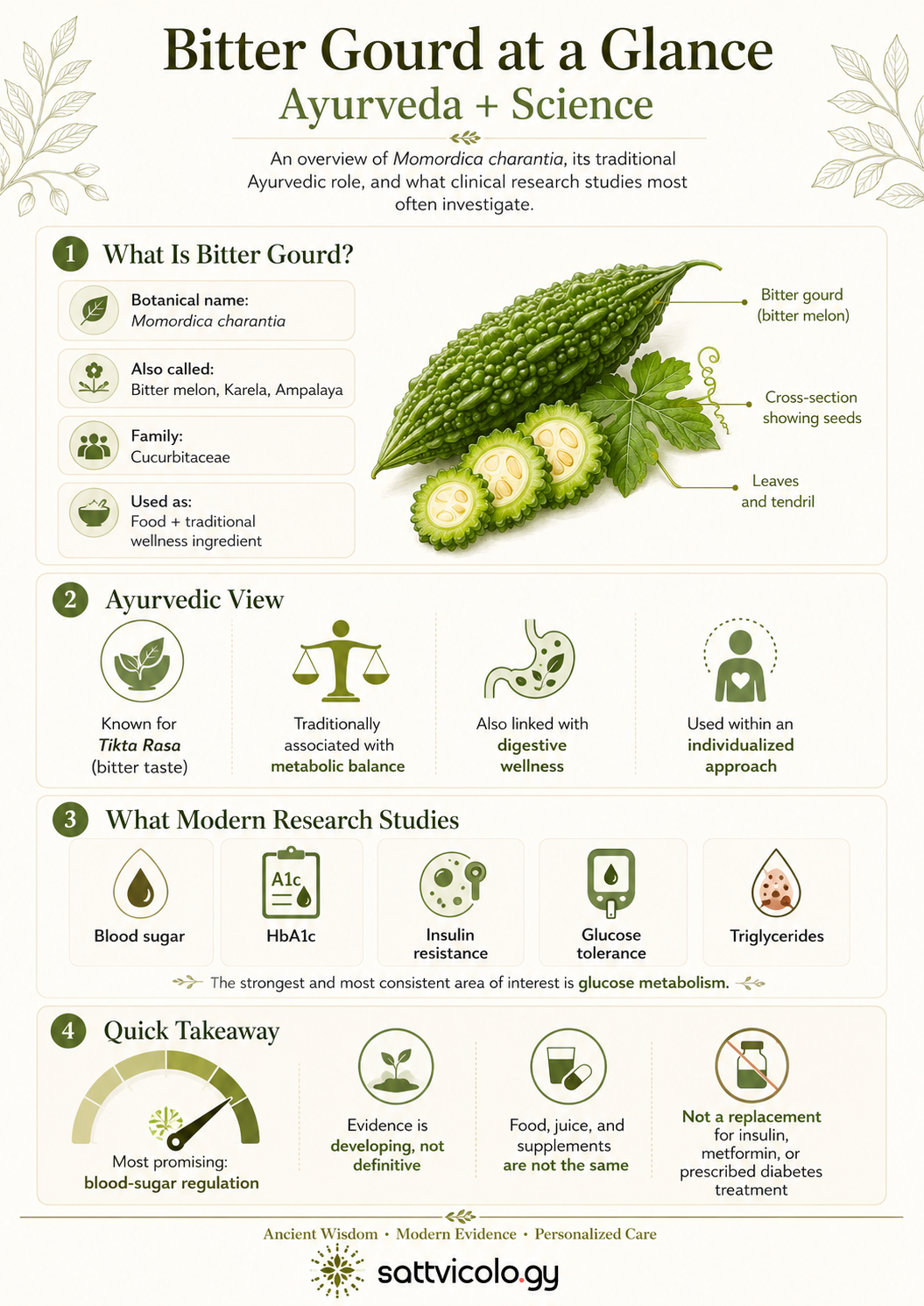
Bitter gourd, also known as bitter melon, karela, or Momordica charantia, is a deeply bitter tropical fruit used both as food and in traditional systems of medicine, including Ayurveda. Modern research has focused heavily on bitter melon because of its traditional association with blood-sugar regulation and metabolic health.
What Is Bitter Gourd?
Botanical name: Momordica charantia
Common names: Bitter gourd, bitter melon, karela, balsam pear, ampalaya
Botanical family: Cucurbitaceae
Bitter melon is a climbing vine grown widely in tropical and subtropical regions. Its immature fruit is consumed as a vegetable in India, South Asia, Southeast Asia, China, Africa and the Caribbean.
The plant contains numerous phytochemicals, including cucurbitane-type triterpenoids, saponins, flavonoids, sterol glycosides, peptides and other plant compounds.
Quick answer: Bitter gourd is an Ayurvedic food and edible vegetable studied primarily for blood-sugar regulation and metabolic health.
Why Is Bitter Gourd So Bitter?
Bitter taste is one of the defining characteristics of Momordica charantia. Modern phytochemical research identifies several cucurbitane-type triterpenoids as major contributors to its characteristic bitterness.
From an Ayurvedic perspective, bitterness—or Tikta Rasa—has a different meaning than it does in Western food culture. Bitter foods are traditionally used strategically and are associated with cleansing, digestion, metabolic balance and particular doshic patterns.
This traditional interpretation should be distinguished from modern biochemical explanations involving glucose transport, insulin signaling, enzymes and phytochemicals.
1. Bitter Gourd May Help Support Blood-Sugar Regulation
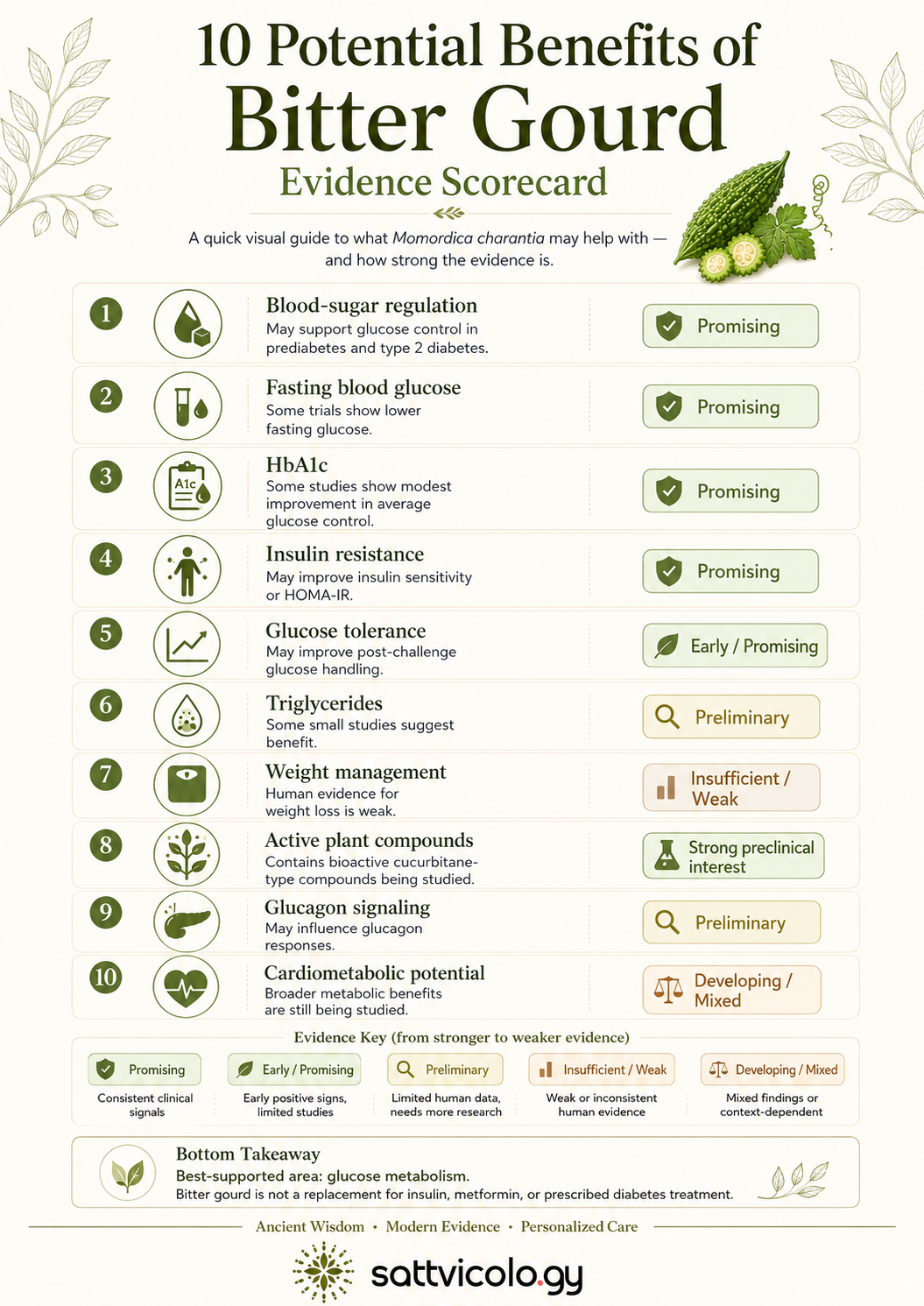
This is the most researched potential benefit of bitter melon.
A 2025 randomized placebo-controlled trial evaluated bitter melon extract in 75 adults with prediabetes. Participants received 300 mg/day, 600 mg/day or placebo for 12 weeks. Both bitter melon groups had a smaller increase in fasting glucose than the placebo group.
Another randomized study involving people with prediabetes found improvements in glucose responses during an oral glucose tolerance test after 12 weeks of bitter melon supplementation.
Evidence level: Promising.
These findings do not establish bitter melon as a stand-alone diabetes treatment.
2. Bitter Melon May Reduce Fasting Blood Glucose
A randomized placebo-controlled clinical trial involving people with type 2 diabetes evaluated bitter melon extract over 12 weeks.
Researchers found that HbA1c did not significantly change compared with placebo, while average fasting glucose decreased in the bitter melon group. No serious adverse events were reported during the intervention.
Evidence level: Promising but inconsistent across studies.
Reducing fasting glucose is not equivalent to demonstrating long-term prevention of diabetic kidney disease, neuropathy, retinopathy, heart attack or stroke.
3. Bitter Melon May Help Lower HbA1c
HbA1c estimates average blood-glucose exposure over approximately two to three months.
Systematic reviews and meta-analyses of randomized trials have reported a statistically significant advantage for bitter melon over placebo for HbA1c in some analyses. More recent pooled evidence has also reported reductions in HbA1c and fasting blood glucose among people with prediabetes or type 2 diabetes.
Evidence level: Promising, but study heterogeneity remains important.
Bitter melon should not be marketed as “natural insulin.”
4. Bitter Melon May Influence Insulin Resistance
Insulin resistance occurs when tissues become less responsive to insulin and plays a central role in prediabetes, type 2 diabetes and metabolic syndrome.
Recent randomized-trial evidence synthesis has reported improvements in insulin concentrations and HOMA-IR among people with prediabetes or type 2 diabetes taking Momordica charantia.
Evidence level: Promising.
Insulin resistance is influenced by abdominal adiposity, physical activity, sleep, genetics, medications, diet and hormonal factors, so bitter melon should be considered one possible complementary intervention rather than a complete metabolic strategy.
5. Bitter Melon May Improve Glucose Tolerance
A randomized placebo-controlled study involving adults with prediabetes evaluated bitter melon extract for 12 weeks.
Researchers found reductions in post-challenge glucose during a 75-gram oral glucose tolerance test, particularly at the 30-minute measurement. They also observed changes in glucagon responses.
Evidence level: Early but clinically interesting.
Glucose-tolerance studies are important because fasting glucose alone does not capture how effectively the body handles glucose after food or a glucose load.
6. Bitter Gourd May Have Modest Effects on Triglycerides
A small randomized double-blind placebo-controlled pilot study involved 24 adults with obesity who received 2,000 mg/day of Momordica charantia or placebo for 12 weeks.
Bitter melon did not produce statistically significant reductions in body weight, BMI, waist circumference or body-fat percentage. However, the intervention significantly reduced triglycerides and VLDL cholesterol within the bitter melon group.
Evidence level: Preliminary.
This is not enough evidence to recommend bitter melon as a lipid-lowering treatment.
7. Does Bitter Gourd Help With Weight Loss?
Bitter melon is frequently promoted as a weight-loss food or supplement, but human evidence does not currently justify strong claims.
In a randomized obesity pilot study, participants taking bitter melon experienced numerical reductions in body weight, BMI, waist circumference and body-fat percentage, but the changes were not statistically significant.
Evidence level: Insufficient for a weight-loss claim.
A more accurate statement is that bitter melon may influence metabolic pathways, but it is not a clinically proven weight-loss treatment.
8. Bitter Melon Contains Metabolically Active Plant Compounds
Bitter melon contains a wide variety of plant compounds being investigated for glucose-related effects, including several cucurbitane-type triterpenoids.
Researchers have studied these compounds in relation to glucose uptake, insulin-related signaling, glucose metabolism and cellular metabolic pathways.
Evidence level: Strong preclinical interest.
This does not mean every individual compound has been clinically proven in humans.
9. Bitter Melon May Influence Glucagon Signaling
Glucagon is a hormone involved in maintaining blood glucose by stimulating glucose production when needed.
A randomized study in people with prediabetes found reduced glucagon levels at a particular time point during oral glucose-tolerance testing after 12 weeks of bitter melon extract. Researchers proposed that suppression of glucagon may be one mechanism contributing to glucose-related effects.
Evidence level: Preliminary.
This finding requires replication before strong mechanistic claims can be made.
10. Bitter Gourd May Have Broader Cardiometabolic Potential
Because bitter melon has been studied in connection with glucose, HbA1c, insulin, insulin resistance, triglycerides, VLDL and obesity-related measurements, researchers increasingly view it through the broader lens of cardiometabolic health.
Earlier systematic reviews found no significant overall improvement across many metabolic-syndrome outcomes when studies were pooled, while more recent individual trials have produced somewhat more favorable findings.
Evidence level: Developing.
That evolving evidence is exactly why conclusions should not be overstated.
Bitter Gourd Through an Ayurvedic Lens
In Ayurveda, bitter gourd is traditionally known as Karavellaka or commonly as Karela. Its characteristically bitter taste is known as Tikta Rasa.
Ayurvedic assessment traditionally considers much more than one blood test. A practitioner may consider Prakriti, Vikriti, Agni, Ama, appetite, digestion, elimination, body weight, energy, sleep, physical activity, diet, medications and blood-sugar patterns.
At Sattvicolo.gy, bitter gourd should therefore not be presented simply as “the Ayurvedic cure for diabetes.”
A more authentic Ayurvedic question is: Does bitter gourd fit this individual’s metabolic state, constitution, digestion, diet, medications and broader treatment plan?
Bitter Gourd and Diabetes: Ayurveda Meets Modern Metabolic Medicine
The overlap between traditional use and modern research is particularly interesting.
Bitter melon has a long history of use for glucose-related conditions in traditional medicine, and contemporary researchers have repeatedly investigated the plant for diabetes and prediabetes.
Modern studies have investigated effects involving glucose → insulin → insulin resistance → HbA1c → glucagon → metabolic health.
This does not mean traditional Ayurvedic explanations and contemporary endocrinology are identical. It does mean bitter melon represents an interesting area where an ancient dietary practice has generated substantial modern scientific interest.
Is Bitter Melon “Plant Insulin”?
The phrase “plant insulin” is frequently used online, but it is misleading if interpreted literally.
Bitter melon contains peptides and other compounds investigated for insulin-like or glucose-related activity, but eating bitter melon or taking a supplement is not equivalent to injecting pharmaceutical insulin.
People with type 1 diabetes must never substitute bitter melon for insulin. People with type 2 diabetes should also not stop diabetes medication because they begin consuming bitter melon.
Can Bitter Gourd Reverse Diabetes?
There is currently no clinical evidence establishing that bitter melon reverses type 1 or type 2 diabetes.
Clinical studies have measured intermediate outcomes such as fasting glucose, HbA1c, insulin, HOMA-IR and oral glucose tolerance.
Improvement in one or more of these biomarkers is not equivalent to curing diabetes.
Can Bitter Melon Regenerate Pancreatic Beta Cells?
Laboratory and animal research has investigated bitter melon in connection with pancreatic beta-cell function.
However, claims that bitter melon regenerates pancreatic beta cells in humans are not established by high-quality clinical trials.
Therefore, “Bitter melon rebuilds the pancreas” is not an evidence-based human clinical claim.
Bitter Gourd as Food vs. Bitter Melon Supplements
Bitter Gourd as Food
Bitter gourd may be cooked in curries, stir-fried, steamed, added to soups, stuffed or incorporated into other vegetable dishes.
Concentrated Preparations
Bitter melon may also be sold as juice, powder, capsules, extracts, tea or concentrated herbal formulations.
These are not nutritionally or pharmacologically identical. A concentrated extract used in a clinical trial cannot automatically be compared with a serving of cooked karela.
Likewise, 300 mg of one extract is not automatically equivalent to 300 mg of another extract. The formulation, extraction technique, plant part, concentration and phytochemical standardization can all differ.
Bitter Gourd Juice, Dosage, Timing and Daily Use
Bitter Gourd Juice: Is It Better?
Karela juice is widely promoted for blood-sugar control, but clinical evidence does not establish that fresh bitter-gourd juice is universally more effective than cooked bitter melon, standardized extracts or powder.
How Much Bitter Melon Should You Take?
There is no single universally established medicinal dosage. Clinical studies have used substantially different formulations, including 300 mg/day, 600 mg/day and 2,000 mg/day in different trials. These are research protocols—not individualized dosage recommendations.
When Is the Best Time to Take Bitter Gourd?
There is no universally established scientific “best time” for concentrated bitter-melon supplementation.
Can You Eat Bitter Gourd Every Day?
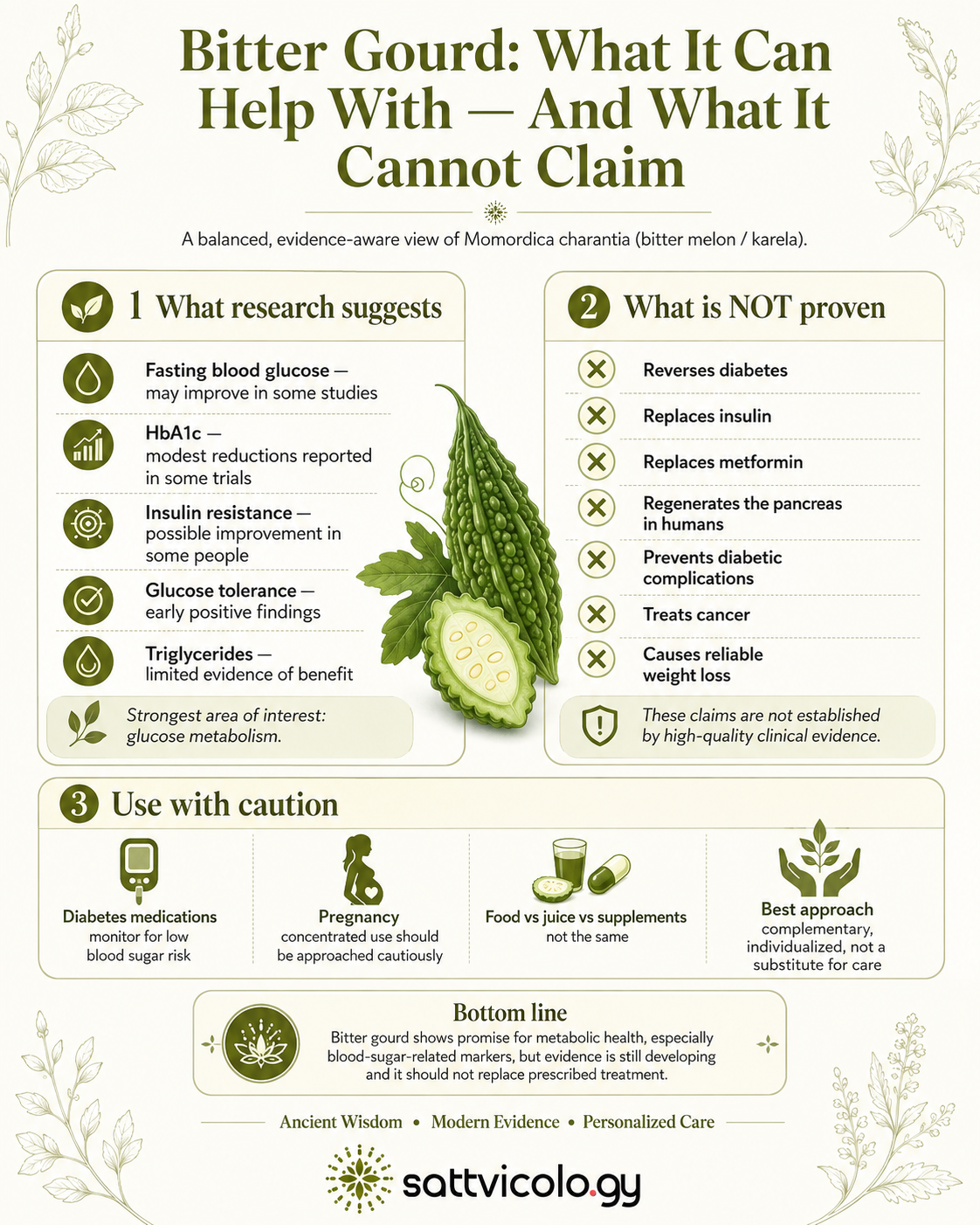
Bitter gourd is consumed regularly as a food in many cultures, but ordinary food consumption and medicinal supplementation are not equivalent. People using it specifically to influence glucose levels should consider regular monitoring, especially if diabetes medications are also being used.
Who Should Be Particularly Careful With Bitter Melon?
Professional guidance is especially important if you:
- Have type 1 diabetes
- Have type 2 diabetes
- Have recurrent hypoglycemia
- Take insulin or diabetes medication
- Are pregnant or breastfeeding
- Have significant liver or kidney disease
- Are preparing for surgery
- Use multiple glucose-lowering herbs or supplements
- Are giving concentrated preparations to a child
Bitter Melon and Pregnancy
Animal research has raised reproductive and developmental safety concerns with concentrated bitter-gourd preparations, while adequate human pregnancy safety evidence is lacking.
Medicinal or concentrated bitter-melon preparations should not be casually self-prescribed during pregnancy.
What Does Modern Science Actually Say About Bitter Gourd?
The most responsible summary is:
Evidence is most promising for:
- Fasting blood glucose
- HbA1c
- Glucose tolerance
- Insulin resistance
Evidence is preliminary or inconsistent for:
- Triglycerides
- Cholesterol
- Body weight
- BMI
- Waist circumference
- Blood pressure
- Cardiovascular risk reduction
Evidence is insufficient for claiming that bitter melon:
- Cures or reverses diabetes
- Replaces insulin or metformin
- Regenerates pancreatic beta cells in humans
- Prevents diabetic kidney disease, neuropathy or retinopathy
- Prevents heart attacks
- Clears blocked arteries
- Cures obesity
- Treats cancer
- “Detoxes” the pancreas
Does bitter melon prevent diabetes complications? There is currently insufficient human clinical evidence to conclude that it prevents kidney failure, neuropathy, retinopathy, heart attacks, stroke or diabetic foot complications.
Does bitter melon fight cancer? Laboratory research is not sufficient to establish it as a human cancer treatment.
Is bitter melon good for cholesterol? Human evidence remains mixed and insufficient to replace established lipid-lowering treatment.
The Sattvicolo.gy Perspective
Few vegetables illustrate the potential relationship between food and medicine as clearly as bitter gourd.
It is simultaneously: A vegetable → a traditional Ayurvedic food → a source of bioactive compounds → a subject of modern diabetes research.
That makes bitter gourd particularly relevant to Sattvic living, but it also creates a danger of oversimplification.
At Sattvicolo.gy, a responsible integrative approach combines individualized Ayurvedic assessment, food and lifestyle guidance, appropriate laboratory monitoring and conventional medical care where necessary.
Research References
- Guarneiri LL, Wilcox ML, Kuan CM, Maki KC. Investigation of the Influence of a Bitter Melon Product on Indicators of Cardiometabolic Health in Adults with Prediabetes. Journal of the American Nutrition Association. 2025;44(4):306-314.
- Kim B, Lee HS, Kim HJ, et al. Momordica charantia (bitter melon) efficacy and safety on glucose metabolism in Korean prediabetes participants: a 12-week, randomized clinical study. Food Science and Biotechnology.
- Kim SK, Jung J, Jung JH, et al. Hypoglycemic efficacy and safety of Momordica charantia (bitter melon) in patients with type 2 diabetes mellitus. Complementary Therapies in Medicine. 2020;52:102524.
- The metabolic effect of Momordica charantia cannot be determined based on the available clinical evidence: a systematic review and meta-analysis of randomized clinical trials.
- Cortez-Navarrete M, Méndez-Del Villar M, Martínez-Abundis E, et al. Effect of Momordica charantia Administration on Anthropometric Measures and Metabolic Profile in Patients with Obesity: A Pilot Clinical Trial. Journal of Medicinal Food. 2022;25(6):645-651.
- Çiçek SS. Momordica charantia L.—Diabetes-Related Bioactivities, Quality Control, and Safety Considerations. Frontiers in Pharmacology. 2022;13:904643.
- Liu L, Lin Z, Cai X, et al. The bitterness, biosynthesis, chemical transformation, and antidiabetic activity of cucurbitane-type triterpenoids from bitter gourd (Momordica charantia L.). Food Chemistry. 2025.
- Chaturvedi P. Antidiabetic potentials of Momordica charantia: multiple mechanisms behind the effects. Journal of Medicinal Food. 2012;15(2):101-107.
Frequently Asked Questions About Bitter Gourd
Bitter gourd, also called bitter melon or karela, is the fruit of Momordica charantia, a tropical vine in the cucumber family. It is eaten as a vegetable and has a long history in traditional medicine.
The strongest human research involves blood-glucose regulation. Clinical studies suggest potential improvements in fasting glucose, glucose tolerance, HbA1c, insulin and insulin resistance in some people with prediabetes or type 2 diabetes.
Bitter melon may modestly improve certain glucose measurements, but evidence is not strong enough to use it as a replacement for established diabetes treatment.
Several randomized studies indicate that bitter melon can lower fasting or post-meal glucose measurements in some participants. Effects vary between studies and products.
Some systematic reviews and randomized-trial analyses report modest reductions in HbA1c, although results have been inconsistent across studies.
No high-quality clinical evidence establishes that bitter melon reverses diabetes.
No. Current evidence does not establish bitter melon as an equivalent substitute for metformin or other prescribed diabetes therapies.
No. Some compounds in bitter melon have demonstrated insulin-related activity experimentally, but bitter melon is not pharmaceutical insulin and should never replace insulin treatment.
Recent pooled randomized-trial evidence suggests possible improvements in insulin and HOMA-IR. More standardized clinical trials are needed.
Current human evidence does not demonstrate a reliable clinically significant weight-loss effect.
One small randomized obesity study found lower triglycerides and VLDL after supplementation, but broader evidence remains inconsistent.
Because bitter melon can affect blood glucose, combining concentrated preparations with diabetes medicines could potentially result in excessive glucose lowering.
Adequate human pregnancy safety evidence is lacking, and animal research has raised reproductive and developmental concerns with concentrated preparations. Medicinal use during pregnancy should therefore be avoided unless specifically advised by an appropriate healthcare professional.
Explore Ayurveda With Individualized Guidance
Bitter gourd may be useful for some people, but Ayurveda considers the whole individual. If you are exploring karela for metabolic wellness, consider guidance that accounts for constitution, digestion, diet, lifestyle, medications and laboratory monitoring.
Medical Disclaimer
The information provided on Sattvicolo.gy is for educational and informational purposes only. It is not intended to diagnose, treat, cure or prevent disease and should not replace professional medical advice, diagnosis, laboratory monitoring or treatment.
Bitter gourd is an ordinary food in many cultures, but concentrated bitter-melon juices, extracts, powders and supplements may have stronger physiological effects than normal culinary servings.
Because human clinical studies indicate that Momordica charantia can influence blood glucose, people taking insulin or glucose-lowering medication should use concentrated preparations only with appropriate professional guidance.
Do not discontinue or reduce insulin, metformin, GLP-1 medications, sulfonylureas, SGLT2 inhibitors or other diabetes treatment based on information on this page.
Pregnant people should avoid self-prescribing concentrated bitter-melon preparations because adequate human pregnancy safety evidence is lacking and animal research has raised potential reproductive concerns.
Seek medical attention for severe or recurrent symptoms of hypoglycemia, including confusion, fainting, seizures, profound weakness or impaired consciousness.