Brahmi: 10 Potential Benefits of Ayurveda’s Legendary Herb for Memory, Focus & the Mind
A.P. Shrilata,
BAMS, PGDND, YIC, Certified Ayurvedic Provider.
Sattvicology Healthcare Team
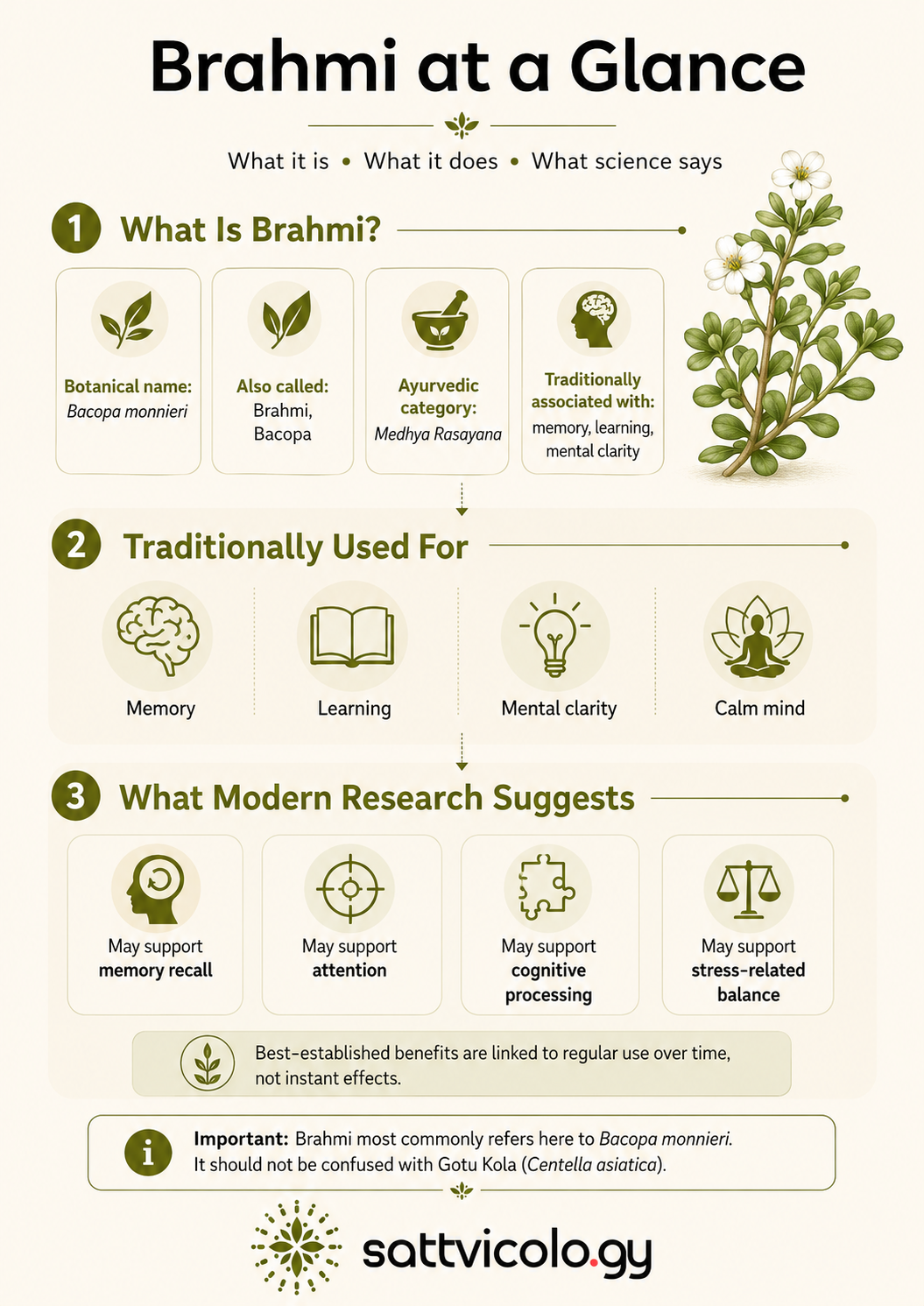
Brahmi (Bacopa monnieri) is one of Ayurveda’s best-known herbs for the mind. Traditionally classified as a Medhya Rasayana, it has long been associated with memory, learning, mental clarity and a calm mind. Modern human research suggests standardized Bacopa extracts may support certain aspects of memory, attention and cognitive processing.
What Is Brahmi?
Botanical name: Bacopa monnieri
Common names: Brahmi, Bacopa, Water Hyssop, Herb of Grace
Brahmi is a small creeping plant that grows naturally in wet and marshy environments.
Its principal phytochemicals include a family of triterpenoid saponins known as bacosides, along with additional compounds including bacopasaponins and other plant constituents. These compounds are believed to contribute to many of Bacopa’s experimentally observed neurological effects.
Modern Bacopa supplements commonly standardize extracts according to their bacoside content.
Different Bacopa extracts are not necessarily equivalent.
Clinical studies have used different extraction methods, bacoside concentrations, dosages and formulations. That makes product identification important when interpreting research.
Quick Answer: What Is Brahmi Good For?
Brahmi (Bacopa monnieri) is an Ayurvedic Medhya Rasayana traditionally used to support memory, learning, mental clarity and a calm mind. Human studies suggest that standardized Bacopa extracts may improve certain measures of memory, recall, attention and cognitive processing after several weeks of regular use. Preliminary research also suggests potential effects on stress and anxiety-related symptoms.
- Memory recall
- Learning
- Attention
- Cognitive processing
- Healthy cognitive aging
- Stress resilience
- Certain anxiety measurements
Evidence for treating neurological diseases is much less established.
Brahmi or Brahma: What Is the Correct Name?
The Ayurvedic herb is generally called Brahmi.
The name has historical associations with Brahma/Brahman and consciousness, knowledge or intellect, helping explain Brahmi’s traditional reputation as an herb of the mind.
For scientific and SEO purposes, use Brahmi (Bacopa monnieri) rather than simply “Brahma herb.” This helps distinguish the botanical from religious or philosophical uses of the word Brahma.
Is Brahmi the Same as Gotu Kola?
Not necessarily.
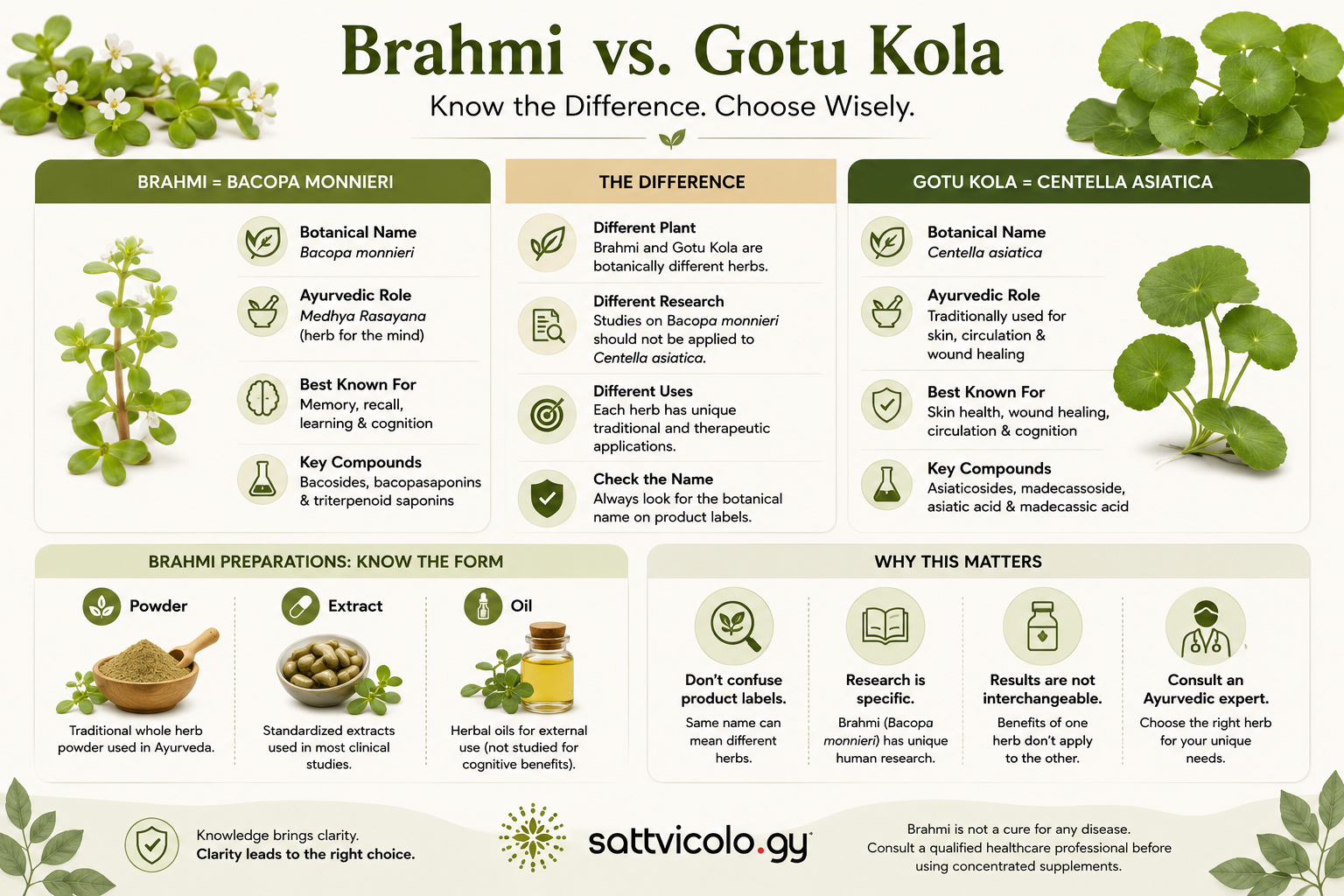
The term Brahmi has sometimes been used regionally for both:
- Bacopa monnieri
- Centella asiatica — Gotu Kola or Mandukaparni
They are different plants.
Modern clinical research referring to Bacopa monnieri should therefore not automatically be applied to Gotu Kola.
On Sattvicolo.gy, this page should consistently identify: Brahmi = Bacopa monnieri and discuss Gotu Kola separately.
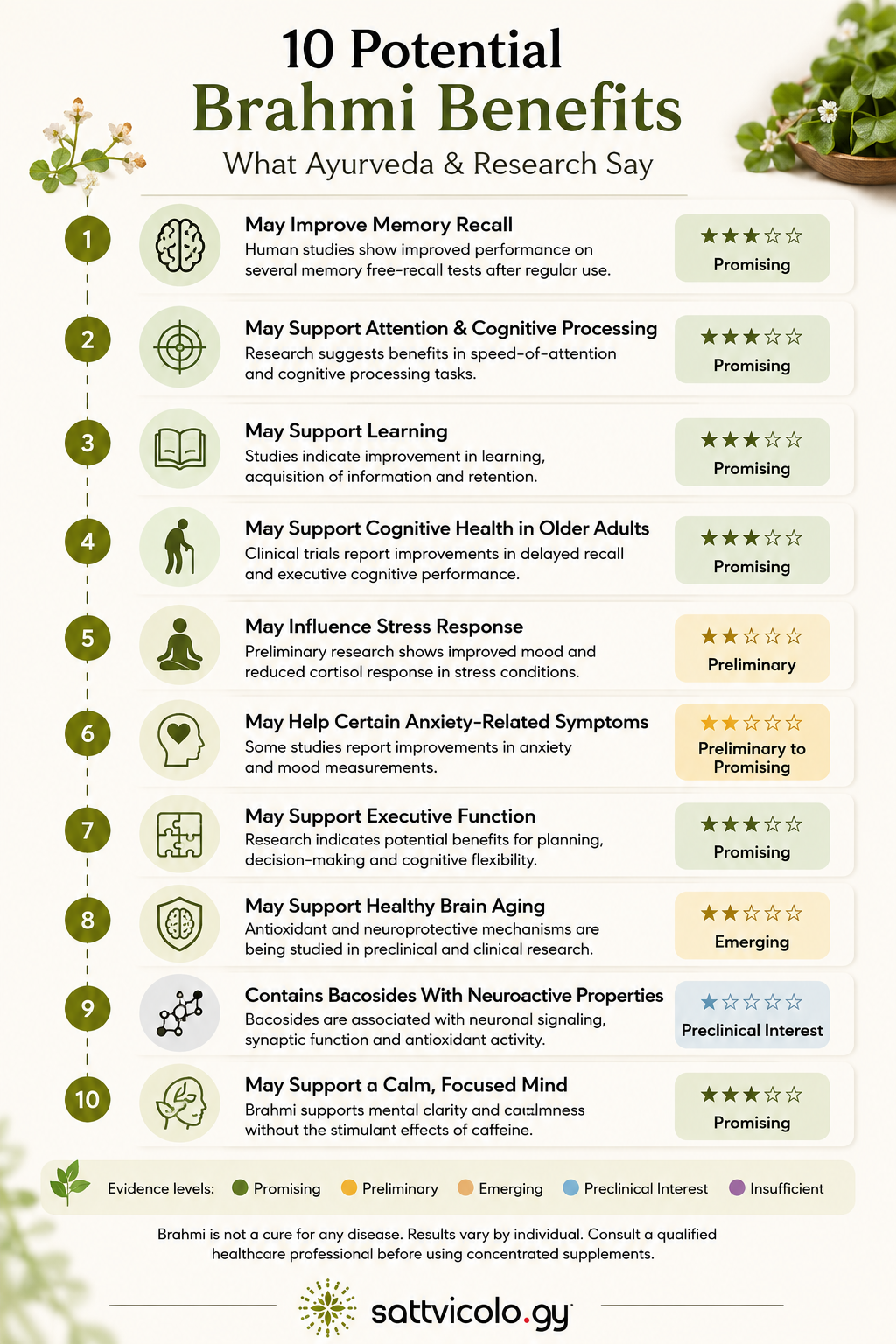
1. Brahmi May Improve Memory Recall
Memory is the best-researched human application of Brahmi.
A systematic review examining randomized controlled trials in healthy adults found six eligible studies, all lasting approximately 12 weeks.
Across the studies, Bacopa improved performance on 9 of 17 memory free-recall measures.
The researchers concluded that there was evidence supporting an effect on memory recall, while benefits across other cognitive domains were less consistently demonstrated.
Evidence level: Promising to moderate.
An important takeaway is that Brahmi appears more strongly associated with memory performance after regular supplementation than with an immediate stimulant-like boost.
2. Brahmi May Support Attention and Cognitive Processing
A meta-analysis examined nine randomized studies, with 518 participants included overall and 437 eligible for pooled cognitive analysis.
The analysis found improvements in particular cognitive measures, including trail-making performance and choice reaction time.
Researchers concluded that Bacopa may improve cognition, particularly aspects related to speed of attention.
Evidence level: Promising.
This does not mean Brahmi makes everyone instantly more focused. The majority of positive chronic cognitive studies have involved supplementation lasting around 12 weeks.
3. Brahmi May Support Learning
Memory and learning are closely interconnected.
Several randomized Bacopa trials have evaluated acquisition of information, delayed recall, verbal learning and retention.
The systematic-review literature suggests that memory acquisition and recall are among the cognitive areas in which Bacopa has demonstrated the most consistent effects.
Evidence level: Promising.
For students, professionals and older adults, this is more defensible than marketing Brahmi as an herb that simply “raises IQ.”
4. Brahmi May Support Cognitive Health in Older Adults
One randomized, double-blind, placebo-controlled trial investigated Bacopa in 54 healthy adults aged 65 years or older.
Participants received either 300 mg/day standardized Bacopa monnieri extract or placebo for 12 weeks.
Compared with placebo, the Bacopa group showed improvements in delayed word recall and certain measures of executive cognitive performance.
Evidence level: Promising.
Importantly, the participants were older adults without dementia. This supports investigation of Bacopa for healthy cognitive aging—not a claim that Brahmi treats Alzheimer’s disease.
5. Brahmi May Influence Stress Response
Brahmi is traditionally associated with a calm, balanced mind. Modern research has begun exploring this area.
In a small double-blind placebo-controlled crossover trial, 17 healthy adults received acute doses of a standardized Bacopa extract.
Researchers reported some improvements in cognitive performance during multitasking, certain positive mood changes and reduced cortisol responses under the experimental conditions.
Evidence level: Preliminary.
The study is interesting because it connects traditional calming uses of Brahmi with contemporary stress physiology. However, one small study is not sufficient to claim that Brahmi “balances cortisol.”
6. Brahmi May Help Certain Anxiety-Related Symptoms
The older-adult randomized trial also measured anxiety and mood.
Participants taking Bacopa experienced improvements in combined state-and-trait anxiety scores compared with placebo during the study.
The acute stress study also observed mood and cortisol findings that support continued investigation of Bacopa’s stress-related properties.
Evidence level: Preliminary to promising.
Brahmi has not been established as a replacement for treatment of generalized anxiety disorder, panic disorder, PTSD, major depression or severe psychiatric illness. Persistent anxiety symptoms deserve appropriate professional evaluation.
7. Brahmi May Support Executive Function
Executive function describes higher-level cognitive processes involved in planning, shifting attention, decision-making, working with information and inhibiting irrelevant responses.
A 2026 network meta-analysis examining plant-derived interventions in healthy older adults found that Bacopa-containing interventions ranked relatively highly for certain executive-function outcomes.
However, network meta-analysis rankings should be interpreted cautiously because they compare different trials, products, populations and interventions.
Evidence level: Promising but variable.
8. Brahmi May Support Healthy Brain Aging
Researchers are interested in Bacopa because of its combination of cognitive effects, bacoside content, antioxidant mechanisms, cholinergic signaling research and neuroprotective mechanisms in experimental models.
A 2026 review examining Bacopa from preclinical and clinical perspectives emphasized its continued promise for neuroprotective research while highlighting the substantial gap between laboratory findings and proven clinical applications.
Evidence level: Clinical evidence for cognition; largely preclinical evidence for neuroprotection.
It is reasonable to say: “Brahmi is being studied for healthy cognitive aging.” It is not reasonable to say: “Brahmi prevents neurodegeneration.”
9. Brahmi Contains Bacosides With Neuroactive Properties
Bacosides are the compounds most frequently associated with Bacopa monnieri research.
Experimental research has studied them in connection with neuronal signaling, synaptic processes, oxidative stress, cholinergic systems, neuroinflammation and memory-related pathways.
Recent research continues to characterize Bacopa’s phytochemistry and potential neuroprotective mechanisms.
Evidence level: Strong preclinical interest.
But a biochemical mechanism does not prove a clinical treatment effect. Statements such as “Bacosides repair brain cells” should be avoided unless referring specifically to experimental findings.
10. Brahmi May Support a Calm, Focused Mind Without Acting Like a Stimulant
One reason Brahmi is unusual is that its traditional reputation combines mental clarity + memory + calmness rather than stimulation alone.
Modern research broadly reflects this pattern. Clinical studies have examined both cognitive performance and stress-related outcomes, leading some scientific discussions to describe Bacopa as a calming cognitive enhancer.
Unlike caffeine, however, most evidence for memory benefits comes from regular use over several weeks, not from an immediate stimulant effect.
Evidence level: Promising for chronic cognitive support.
Brahmi Through an Ayurvedic Lens
Ayurveda traditionally considers Brahmi a Medhya Rasayana.
The Sanskrit concept Medhya relates broadly to intellect, cognition, understanding and mental capacity. Rasayana relates to rejuvenative approaches intended to sustain resilience and healthy physiological function.
An Ayurvedic assessment may consider:
- Prakriti — underlying constitution
- Vikriti — current imbalance
- Vata
- Pitta
- Kapha
- Agni
- Sleep
- Mental overstimulation
- Stress
- Emotional state
- Digestion
- Diet
- Daily routine
- Age
- Current medications
- Cognitive complaints
At Sattvicolo.gy, Brahmi should be approached as part of an individualized strategy for mental wellness rather than a universal nootropic.
What Is a Medhya Rasayana?
Medhya Rasayana is a traditional Ayurvedic concept referring to rejuvenative substances associated particularly with mental and cognitive wellness.
Traditionally, these may be discussed in connection with memory, intellect, learning, concentration, mental clarity and emotional balance.
Modern neuroscience uses a very different framework involving neurotransmitters, synaptic signaling, processing speed, executive function and memory consolidation.
These frameworks should not be presented as identical. But their overlap helps explain why Brahmi has become such an important subject of contemporary cognition research.
Brahmi and Alzheimer's Disease: What Does the Evidence Say?
Brahmi has generated considerable interest in Alzheimer’s disease because of its traditional cognitive use and preclinical neuroprotective research.
Brahmi has not been proven to prevent or cure Alzheimer’s disease.
A randomized Phase 2b study has compared Bacopa with donepezil in people with Alzheimer’s disease or mild cognitive impairment, but the broader clinical evidence remains insufficient to replace established medical treatment.
A new clinical study specifically investigating Bacopa for amnestic mild cognitive impairment and early Alzheimer’s disease is also underway, with its primary findings planned for future publication. As of the published 2026 protocol, final efficacy results were not yet available.
Evidence level: Insufficient for Alzheimer’s treatment claims.
Does Brahmi Prevent Dementia?
No high-quality clinical evidence currently establishes that Brahmi prevents dementia.
Clinical trials in healthy adults show certain memory and cognitive effects. That is different from demonstrating that long-term Bacopa supplementation reduces the incidence of Alzheimer’s disease, vascular dementia, Lewy body dementia or frontotemporal dementia.
These outcomes would require much larger and longer studies.
Is Brahmi Good for ADHD?
Brahmi is frequently promoted for ADHD.
Some studies have explored Bacopa in children and adolescents, but the evidence base is substantially weaker than it is for memory research in healthy adults.
Current evidence does not establish Bacopa as an alternative to standard ADHD treatment.
Brahmi should not replace an appropriate ADHD evaluation, behavioral treatment, educational support or prescribed medication.
Evidence level: Insufficient for replacing established ADHD treatment.
Does Brahmi Work Immediately?
Probably not for its best-established cognitive effects.
One small acute study observed certain effects one to two hours after standardized Bacopa administration. However, the more substantial memory literature involves chronic supplementation, commonly around 12 weeks.
For patient education, avoid claims such as: “Take Brahmi and instantly focus.”
The evidence more strongly supports gradual cognitive effects with consistent use of specific standardized extracts.
How Long Does Brahmi Take to Work?
Many of the randomized cognition trials lasted approximately 12 weeks.
That does not mean every person will notice a benefit exactly at 12 weeks. It means that clinical evidence has generally evaluated outcomes after weeks of regular supplementation rather than after one or two doses.
How Much Brahmi Should You Take?
There is no universal Brahmi dose appropriate for every person.
In the systematic review of adult cognition trials, standardized extracts were generally studied at approximately 300–450 mg/day for around 12 weeks.
The healthy older-adult trial used 300 mg/day of standardized Bacopa extract for 12 weeks.
These are research protocols, not individualized dosage recommendations.
A 300 mg extract standardized to one concentration of bacosides may differ substantially from another 300 mg product.
Brahmi Powder vs. Brahmi Extract
These should not automatically be treated as equivalent.
Traditional Brahmi preparations may include:
- Whole herb
- Powder
- Decoctions
- Ghee-based formulations
- Oils
- Combination preparations
Modern research often uses:
- Concentrated extracts
- Standardized bacoside preparations
- Capsules or tablets
The clinical research discussed on this page largely involves standardized extracts, so the results cannot automatically be transferred dose-for-dose to traditional Brahmi powder.
Brahmi Oil vs. Oral Brahmi
Brahmi oil is another source of confusion.
Some products marketed as Brahmi oil contain Bacopa monnieri, Centella asiatica, or mixtures of herbs infused into a carrier oil.
Therefore, research on orally consumed standardized Bacopa monnieri extract does not establish that Brahmi hair oil produces the same cognitive effects.
Always check the botanical ingredient rather than relying only on the product name “Brahmi.”
Is Brahmi Safe?
Bacopa appears reasonably well tolerated in many short-term human trials.
The most common reported adverse effects are gastrointestinal, including:
- Nausea
- Abdominal discomfort or cramping
- Increased stool frequency
- Diarrhea or digestive changes
Clinical reviews also note the possibility of medication interactions and recommend caution in certain health conditions.
Long-term safety
Most cognitive trials have lasted several weeks to a few months. Evidence establishing the safety of lifelong daily use is substantially more limited.
Who Should Talk to a Healthcare Professional Before Taking Brahmi?
Professional guidance is particularly appropriate if you:
- Are pregnant
- Are breastfeeding
- Are giving Brahmi to a child
- Take several prescription medications
- Take medications affecting acetylcholine
- Take sedative medications
- Have significant gastrointestinal disease
- Have thyroid disease
- Have abnormal heart rate
- Are preparing for surgery
- Have a diagnosed neurological condition
- Have significant psychiatric symptoms
- Are taking dementia medications
Potential pharmacological activity means “natural” should not be interpreted as “interaction-free.”
Brahmi and Thyroid Health
This area requires caution.
Experimental and clinical references have raised the possibility that Bacopa may influence thyroid-related physiology or interact with thyroid medications. The clinical evidence is not sufficient to use Brahmi as a treatment for hypothyroidism or hyperthyroidism.
Anyone taking thyroid replacement or antithyroid medication should discuss regular concentrated Bacopa supplementation with an appropriate healthcare professional.
Can Brahmi Make You Smarter?
There is no evidence that Brahmi permanently increases intelligence.
Clinical evidence suggests possible improvements in particular domains such as memory recall, attention speed and delayed recall.
That is very different from: “Brahmi increases IQ.”
Scientific credibility improves when specific cognitive outcomes are used instead of vague claims of “brain power.”
Brahmi vs. Ashwagandha: What Is the Difference?
Brahmi (Bacopa monnieri)
Human research focuses particularly on memory, learning, recall, attention, cognition and certain stress-related outcomes.
Ashwagandha (Withania somnifera)
Human research focuses more heavily on stress, cortisol, sleep, anxiety-related symptoms, strength and certain hormonal outcomes.
Someone experiencing poor concentration because of severe stress and sleep deprivation may therefore require a very different approach from someone primarily seeking cognitive support. Ayurveda individualizes the recommendation.
Brahmi vs. Gotu Kola: What Is the Difference?
Brahmi
Botanical: Bacopa monnieri
Known particularly in modern clinical research for memory and cognition.
Gotu Kola / Mandukaparni
Botanical: Centella asiatica
A separate plant traditionally used in Ayurveda and other Asian medical traditions.
Because both have sometimes been called “Brahmi,” supplement labels should always include the botanical name.
What Does Modern Science Actually Say About Brahmi?
Evidence is most promising for:
- Memory recall — multiple randomized trials and systematic reviews show favorable effects on certain memory measures.
- Attention and cognitive processing — meta-analysis found improvements in selected processing and attention-related outcomes.
- Cognitive performance in healthy older adults — randomized research has reported improvements in delayed recall and certain executive measures.
Evidence is emerging for:
- Stress response
- Anxiety-related symptoms
- Healthy cognitive aging
Evidence is insufficient for claiming Brahmi:
- Cures Alzheimer’s disease
- Prevents dementia
- Reverses cognitive decline
- Cures ADHD
- Raises IQ
- Treats epilepsy independently
- Replaces antidepressants
- Replaces anxiety medications
- Permanently lowers cortisol
- Regenerates damaged brain cells in humans
- Prevents Parkinson’s disease
Frequently Asked Questions About Brahmi
Brahmi commonly refers to Bacopa monnieri, an Ayurvedic herb traditionally classified as a Medhya Rasayana and associated with memory, intellect, learning and mental clarity.
The strongest clinical evidence involves certain aspects of memory, recall, attention and cognitive processing. Preliminary research also suggests possible stress- and anxiety-related effects.
Several randomized clinical trials suggest that standardized Bacopa extracts can improve selected memory measures, particularly free recall and delayed recall after regular supplementation.
Brahmi has been studied for learning, recall and cognitive processing, but it is not an immediate stimulant and most positive memory research involves supplementation over several weeks.
Meta-analytic evidence suggests possible benefits in selected attention and cognitive-processing tasks, although effects are not consistent across every measure.
Many of the better-known cognitive trials evaluated outcomes after approximately 12 weeks of regular supplementation.
Some human studies have reported improvements in anxiety-related measurements, but the evidence is not sufficient to use Brahmi as a replacement for established anxiety treatment.
One small acute randomized experiment observed reduced cortisol responses under multitasking stress conditions. Larger trials are needed before claiming that Brahmi reliably lowers or “balances” cortisol.
No. There is currently insufficient evidence that Brahmi prevents Alzheimer’s disease.
Brahmi is not an established dementia treatment and should not replace appropriate neurological evaluation or prescribed therapy.
Research interest exists, but current evidence is insufficient to consider Bacopa a replacement for established ADHD diagnosis or treatment.
Yes, when referring to Brahmi (Bacopa monnieri). However, the name Brahmi has occasionally also been used for Centella asiatica, which is a different plant.
No. Bacopa monnieri and Centella asiatica are botanically different plants, even though naming traditions sometimes overlap.
Daily Bacopa has been used in clinical studies for approximately 12 weeks and sometimes longer, but that does not establish universal lifelong safety.
The most commonly described effects are gastrointestinal, including nausea, increased bowel movements and abdominal cramps.
The Sattvicolo.gy Perspective
Modern life constantly demands more from the brain.
Remember more. Focus longer. Multitask faster. Sleep less. Process endless information. Remain productive—and somehow stay calm.
Brahmi is especially interesting because Ayurveda did not traditionally separate mental performance from mental balance.
The traditional concept of Medhya Rasayana recognizes that clarity of mind is connected to more than memory alone.
An individualized Ayurvedic approach may consider: Memory → concentration → sleep → stress → digestion → daily rhythm → diet → mental stimulation → constitution rather than simply recommending a “brain supplement.”
Poor concentration may primarily reflect chronic sleep deprivation, anxiety, depression, medication effects, nutritional deficiencies, thyroid dysfunction, ADHD, menopause, chronic stress or neurological disease.
At Sattvicolo.gy, the goal should not simply be a sharper brain. It should be a healthier relationship between cognition, nervous-system balance, lifestyle and whole-person well-being.
Research References
- Pase MP, Kean J, Sarris J, et al. The cognitive-enhancing effects of Bacopa monnieri: a systematic review of randomized, controlled human clinical trials. Journal of Alternative and Complementary Medicine. 2012.
- Kongkeaw C, Dilokthornsakul P, Thanarangsarit P, et al. Meta-analysis of randomized controlled trials on cognitive effects of Bacopa monnieri extract. Journal of Ethnopharmacology. 2014.
- Calabrese C, Gregory WL, Leo M, et al. Effects of a standardized Bacopa monnieri extract on cognitive performance, anxiety, and depression in the elderly. Journal of Alternative and Complementary Medicine. 2008.
- Benson S, Downey LA, Stough C, et al. An acute, double-blind, placebo-controlled cross-over study of 320 mg and 640 mg doses of Bacopa monnieri on multitasking stress reactivity and mood. Phytotherapy Research. 2014.
- McPhee GM, Downey LA, Wesnes KA, Stough C. The Neurocognitive Effects of Bacopa monnieri and Cognitive Training on Markers of Brain Microstructure in Healthy Older Adults. Frontiers in Aging Neuroscience. 2021.
- Feng X, Fan S, Wei F. The effect of plant active substances on cognitive function in healthy older adults: a systematic review and network meta-analysis of randomized controlled trials. Frontiers in Pharmacology. 2026.
- Dwivedi A, et al. Efficacy of Bacopa monnieri on Cognitive Function and Alterations in Blood Metabolites in Patients With Amnestic Mild Cognitive Impairment and Early Alzheimer Disease: Protocol for an Exploratory Double-Blind, Randomized, Placebo-Controlled Trial. 2026.
- Walker EA, Pellegrini MV. Bacopa monnieri. StatPearls/NCBI Bookshelf.
Medical Disclaimer
The information provided on Sattvicolo.gy is for educational and informational purposes only. It is not intended to diagnose, treat, cure or prevent any disease and should not replace professional medical advice, diagnosis or treatment.
Brahmi (Bacopa monnieri) is biologically active and may cause adverse effects or interact with medications.
Possible adverse effects include gastrointestinal symptoms such as nausea, abdominal cramping and increased bowel movements.
Consult an appropriately qualified healthcare professional before using concentrated Brahmi supplements if you are pregnant or breastfeeding, are giving supplements to a child, take prescription medication, have thyroid disease, have gastrointestinal disease, have a neurological disorder, are taking medication for dementia or cognitive impairment, are preparing for surgery, or have persistent or unexplained memory problems.
New or worsening memory loss, confusion, personality changes, difficulty speaking, loss of function or other neurological symptoms should receive appropriate medical evaluation rather than being self-treated with supplements.
Do not discontinue prescribed medications based on information on this page.