Kumkumadi Taila (कुमकुमादि तैल): 9 Ayurvedic Benefits for Aging Facial & Neck Skin, Pigmentation, Dryness and Radiance
A classical saffron-centered Ayurvedic facial oil for mature face and neck skin, explored here alongside emerging clinical research on pigmentation, redness, brightness, skin comfort and safe use.
Kumkumadi Taila: Ayurveda’s Legendary Oil for the Face — and Why Aging Skin Deserves More Than Moisturizer
There comes a point when facial skincare changes.
The concern is no longer simply an occasional blemish or dry patch. The skin may begin to feel thinner. Pigmentation becomes less even. Fine lines remain after an expression disappears. The jawline changes. The neck begins to show creasing, dryness or laxity that may seem more noticeable than changes on the face.
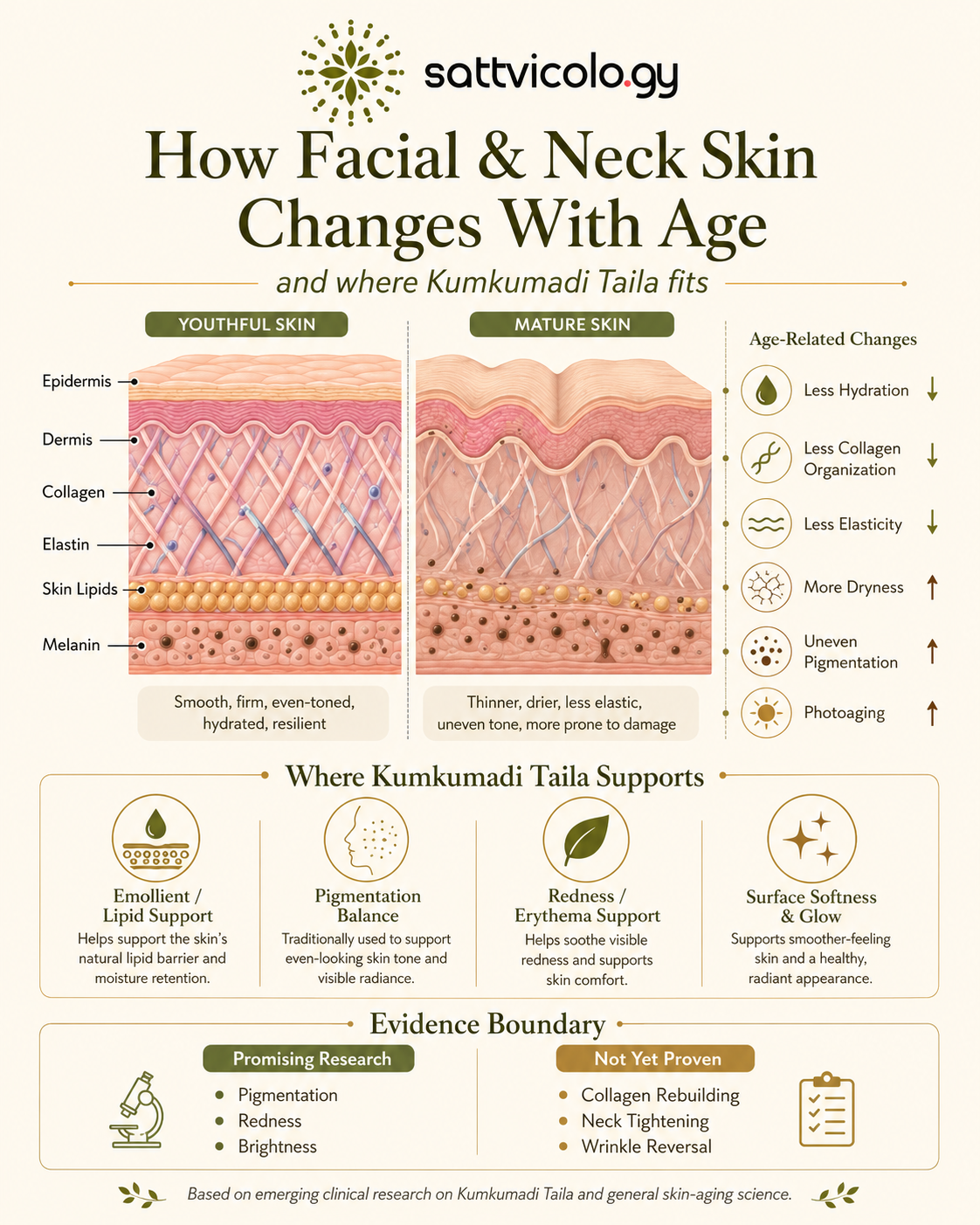
Modern dermatology recognizes skin aging as a complex interaction between intrinsic biological aging and environmental exposure, particularly ultraviolet radiation. Over time, collagen organization, elastin, hydration, barrier function and pigmentation can all change.
Ayurveda approaches aging skin through a different vocabulary. It recognizes that skin gradually acquires qualities associated with increasing Vata—dryness, thinness, roughness and loss of suppleness—while Pitta-related factors may contribute to discoloration, redness and uneven complexion.
Among Ayurveda’s classical facial preparations, few are as celebrated as Kumkumadi Taila (कुमकुमादि तैल). This complex saffron-centered medicated oil has traditionally been used to enhance Varnya, or healthy complexion, and support facial skin quality.
Modern researchers have begun examining the formula with objective instruments. A 2026 instrument-based clinical study evaluated Kumkumadi Taila on facial skin and found measurable changes in pigmentation and redness over 15 days. A separate eight-week pilot study also reported improvement in perceived skin brightness.
What Is Kumkumadi Taila?
Kumkumadi Taila, also written Kumkumadi Tailam, is a classical Ayurvedic medicated facial oil traditionally used to support complexion, pigmentation balance and overall skin vitality.
Its name comes from Kumkuma—saffron (Crocus sativus), one of the formula’s defining ingredients.
The standardized classical preparation used in a 2026 clinical study followed a formulation described in Ashtanga Hridayam. It contained:
- Kumkuma — saffron (Crocus sativus)
- Chandana — sandalwood (Santalum album)
- Rakta Chandana — red sandalwood (Pterocarpus santalinus)
- Padmaka
- Padmakesara — lotus components
- Utpala — blue water lily
- Nyagrodha — banyan
- Plaksha
- Yashtimadhu — licorice (Glycyrrhiza glabra)
- Usheera — vetiver
- Goat milk
- Tila Taila — sesame oil
Classical texts contain minor variations in formula and preparation. Commercial products sold as ‘Kumkumadi oil’ may therefore not be identical to the formulation evaluated clinically.
Why Kumkumadi Taila Becomes Especially Interesting as We Age
Aging skin undergoes changes in virtually every structural layer. Research on cutaneous aging describes reductions in collagen organization, dermal resilience, elasticity and hydration, while ultraviolet radiation accelerates pigment irregularity and structural deterioration.
The face receives enormous attention—but the neck is often neglected. The neck is continuously exposed to sunlight, movement and environmental stress and develops characteristic horizontal creases, textural change and laxity with age.
Kumkumadi Taila has been directly studied on the face, not specifically on aging neck skin. It would therefore be inaccurate to claim that clinical trials prove Kumkumadi Taila reverses neck wrinkles.
However, because the neck is contiguous exposed skin and traditional facial oiling is often extended below the jawline, Kumkumadi Taila may reasonably be used as a cosmetic moisturizing and massage oil for the face, jawline and neck when tolerated.
The evidence for actual anti-aging restructuring of the neck remains unproven.
1. May Help Improve Uneven Facial Pigmentation
Pigmentation is where Kumkumadi Taila currently has some of its most interesting direct human evidence.
A 2026 exploratory study enrolled 30 healthy adults with Fitzpatrick skin types III–IV. Participants applied Kumkumadi Taila once daily for 15 days using a standardized facial massage and wash-off procedure. Skin properties were objectively measured using the DermaLab Combo.
The researchers found a statistically significant reduction in the facial melanin index over time. This is consistent with Ayurveda’s traditional description of Kumkumadi Taila as a Varnya preparation.
The study did not specifically enroll patients with melasma, age spots or post-inflammatory hyperpigmentation. The evidence is therefore promising but preliminary.
2. May Help Reduce the Appearance of Facial Redness
The same 2026 clinical investigation measured facial erythema. The erythema index decreased significantly during the study.
Researchers also chemically profiled the oil and identified compounds including safranal, liquiritin, sesamin, berberine, palmatine, nuciferine and rubiadine, discussed in relation to antioxidant, inflammatory and pigmentation pathways.
This does not mean Kumkumadi Taila should be used to self-treat rosacea, eczema or inflammatory skin disease. Persistent facial redness requires accurate diagnosis.
3. Supports Mature Skin Through Lipid-Based Moisturization
One of the simplest benefits of facial oil is also one of the most important as skin ages: lipid support.
Plant oils can act as emollients and occlusives, helping reduce roughness and support the skin barrier. This becomes especially relevant in mature skin because age-related changes include reduced hydration and alterations in barrier function.
Kumkumadi Taila uses sesame oil as its classical lipid medium. From an Ayurvedic perspective, this unctuous quality helps counterbalance Ruksha—dryness, one of the qualities associated with Vata.
Very dry mature skin may benefit from applying Kumkumadi Taila over a water-based moisturizer rather than using oil alone.
4. May Support a More Radiant Complexion
An eight-week open-label pilot study involving 30 adults aged 20–60 years evaluated daily topical Kumkumadi Tailam.
At Week 8, investigators reported that 56.67% of participants demonstrated very significant improvement in skin brightness, while 26.67% showed significant improvement. Most participants experienced no irritation, although mild irritation occurred in a small percentage.
The study did not include a placebo or comparator group. Two preliminary human studies therefore suggest that regular Kumkumadi Taila use may improve aspects of skin tone and perceived brightness, but larger randomized controlled trials are still needed.
5. Provides Antioxidant-Rich Botanical Compounds
Aging skin is exposed continually to oxidative stress. Ultraviolet radiation, pollution and intrinsic metabolism generate reactive oxygen species that can contribute to inflammation and degradation of extracellular matrix components.
Using UPLC-MS/MS QTOF, researchers identified multiple compounds within the tested oil, including safranal, liquiritin, sesamin, berberine, palmatine, nuciferine and rubiadine.
Saffron itself contains biologically active compounds such as crocin, crocetin and safranal. Their presence creates mechanistic plausibility, but it does not prove that Kumkumadi Taila reverses skin aging.
6. May Support Skin Elasticity — But the Evidence Requires Careful Interpretation
Skin elasticity becomes increasingly important as facial and neck skin ages. Collagen and elastin organization deteriorate with age and photoaging, contributing to laxity, fine lines and altered texture.
The recent Kumkumadi Taila study measured elasticity objectively, but the detailed results reported that the measured elasticity parameter declined over the short 15-day period rather than clearly improving.
We should therefore not claim that this trial proves Kumkumadi Taila increases facial elasticity. Longer studies of three months or more would be necessary to meaningfully evaluate stable structural changes.
Its ability to increase collagen or reverse facial or neck laxity has not yet been clinically established.
7. Facial Massage May Add Benefits Beyond the Oil Itself
Kumkumadi Taila is traditionally applied with gentle facial massage. In the 2026 study, participants applied 3–5 drops, massaged the oil into the face for approximately five minutes, left it for another 15 minutes and then washed it away.
Massage itself can influence the sensory experience of skincare and may affect local circulation and topical distribution. Ayurveda incorporates oil massage—Abhyanga—as part of daily preventive health practices.
For mature facial skin, gentle technique is critical. The goal should be lubrication + gentle movement + consistent application rather than force.
8. Particularly Useful for the Often-Neglected Neck and Décolletage
People commonly invest heavily in facial skincare while stopping products at the jawline. The neck remains exposed to ultraviolet radiation, environmental pollution, repetitive movement, loss of hydration and intrinsic aging.
A well-tolerated facial oil can reasonably be extended from the jawline → front and sides of neck → upper décolletage. This recommendation is based on skincare logic and traditional external use—not on a Kumkumadi-specific neck clinical trial.
For mature neck skin, daily broad-spectrum sunscreen remains considerably better supported for preventing continued photoaging than any Ayurvedic oil. Kumkumadi Taila should complement—not replace—sun protection.
9. May Be Especially Suited to Dry, Dull, Uneven Mature Skin
Kumkumadi Taila may be particularly appealing when the dominant concerns include dryness, dullness, uneven skin tone, mild pigmentation, rough texture, loss of comfortable suppleness and environmentally stressed skin.
The 2026 study found significant changes in pigmentation and redness without a measurable worsening of transepidermal water loss. No adverse events were reported in that 15-day study.
The eight-week pilot also found generally favorable tolerability, although mild irritation occurred in approximately 6.7% of participants. Acne-prone, seborrheic, highly reactive or rosacea-prone skin may respond differently.
What Does the Best Clinical Research Actually Show?
2026 Instrument-Based Facial Skin Study
This is currently one of the most informative instrument-based studies of Kumkumadi Taila.
- Participants: 30 healthy adults
- Skin type: Fitzpatrick III–IV
- Study duration: 15 days
- Treatment: 3–5 drops once daily
- Application: 5-minute massage + 15-minute contact time
- Measurement: DermaLab Combo instrument
- Control group: None
Researchers measured pigmentation/melanin, erythema, hydration, transepidermal water loss, skin thickness and elasticity. The strongest positive findings were reductions in facial melanin index and erythema index. TEWL and skin thickness remained relatively stable, and no adverse events occurred.
What the study does NOT prove
- removes wrinkles
- reverses sagging
- rebuilds collagen
- treats melasma
- eliminates age spots
- reverses photoaging
- tightens the neck
Participants were predominantly young adults and the study lasted only 15 days. Using this trial to claim ‘clinically proven anti-aging’ would therefore overstate the evidence.
The Eight-Week Brightness Study
A second clinical pilot enrolled 30 healthy adults aged 20–60 years who applied Kumkumadi Thailam daily for eight weeks. At Week 8, 56.67% showed very significant improvement in skin brightness and 26.67% showed significant improvement. 93.33% experienced no irritation; 6.67% experienced mild irritation. The absence of a placebo or comparator group substantially limits conclusions.
Kumkumadi Taila and Aging Skin: What Is Proven vs. Traditional?
Better-Supported Emerging Evidence
Kumkumadi Taila may improve measured facial pigmentation, reduce measured erythema/redness, improve perceived skin brightness, provide emollient/oil-based conditioning and deliver identifiable botanical phytochemicals to the skincare formulation.
Traditional but Not Yet Clinically Proven Anti-Aging Claims
Ayurveda traditionally associates Kumkumadi Taila with complexion, vitality and facial skin quality, but current trials do not yet prove that it stimulates collagen production in humans, erases wrinkles, tightens loose skin, reverses neck sagging, permanently removes age spots or reverses chronological aging.
The Key Ingredients and Why They Matter
Kumkuma — Saffron
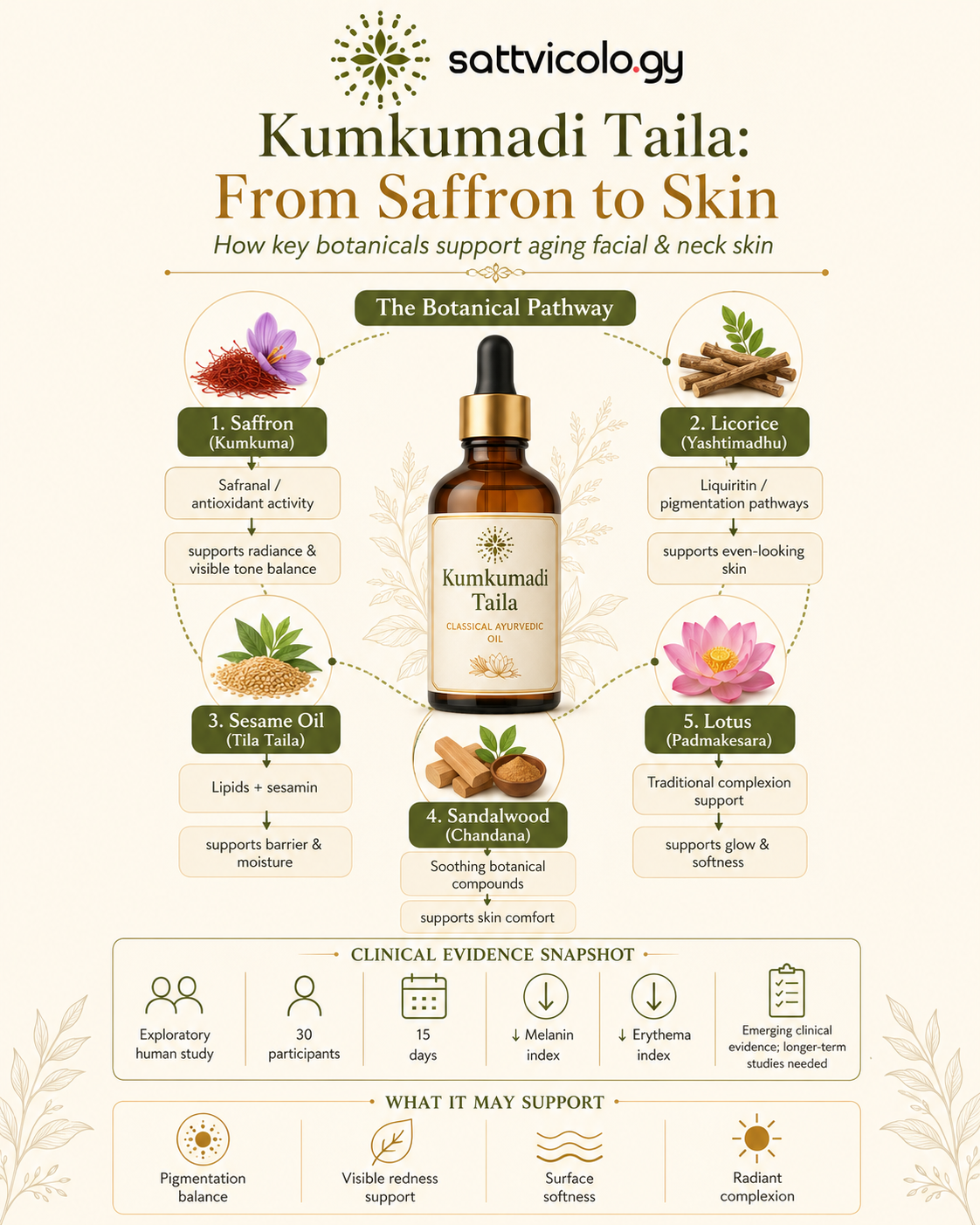
Saffron (Crocus sativus) gives Kumkumadi Taila its name. Its studied constituents include crocin, crocetin, picrocrocin and safranal. Safranal was detected in the clinically tested Kumkumadi Taila sample.
Yashtimadhu — Licorice
Licorice (Glycyrrhiza glabra) contains compounds including glabridin and liquiritin that have attracted dermatologic interest for antioxidant and pigmentation-related properties. Liquiritin was detected directly in the tested oil.
Tila Taila — Sesame Oil
Sesame oil acts as the classical lipid carrier. Sesame contains unsaturated fatty acids and phytochemical antioxidants including lignans such as sesamin; sesamin was also detected in the chemical analysis.
Chandana and Rakta Chandana
Sandalwood and red sandalwood are traditional Ayurvedic complexion-supporting botanicals. Mechanistic findings involving antioxidant, inflammatory and tyrosinase-related activity are not equivalent to large human efficacy trials.
How to Use Kumkumadi Taila on Mature Face and Neck Skin
Evening Application
- Cleanse the face and neck gently.
- Apply 3–5 drops of Kumkumadi Taila across the face.
- For face plus neck, use a few additional drops if needed.
- Massage very gently using fingertips.
- On the neck, use light upward and outward strokes rather than aggressive pulling.
- For a study-aligned routine, massage for about five minutes, leave on for another 15 minutes, then cleanse.
Many commercial formulations are marketed for overnight application, but that was not the protocol used in the recent instrument-based study. If your skin is dry and tolerant, longer application may be comfortable. If acne-prone or reactive, shorter contact time may be wiser.
Should Kumkumadi Taila Be Used Every Night?
The available clinical studies used once-daily application, but that does not mean every person must use it daily.
A practical introduction for mature skin could be:
- Week 1: 2–3 evenings
- Week 2: every other evening if tolerated
- Afterward: increase according to comfort
Skincare consistency matters, but irritation is not a sign that a product is ‘working’.
Kumkumadi Taila and Retinol: Can You Use Both?
Retinoids have substantially stronger clinical evidence than Kumkumadi Taila for treating photoaged skin and improving visible wrinkles.
For someone already using retinol or prescription tretinoin, introducing a complex botanical oil on the same night may increase irritation in sensitive individuals.
A conservative strategy is to alternate nights initially:
- Night A: Retinoid routine
- Night B: Kumkumadi Taila
People using prescription retinoids should follow the guidance of their dermatologist.
Kumkumadi Taila Does Not Replace Sunscreen
This may be the single most important anti-aging point in the entire article.
Ultraviolet radiation is a central driver of extrinsic skin aging, producing cumulative structural damage, pigment change and degradation of collagen-related architecture.
No Ayurvedic facial oil should be presented as a replacement for broad-spectrum sunscreen.
The strongest mature-skin routine combines sun protection + gentle cleansing + appropriate moisturization + evidence-based actives + traditional supportive care when desired. Kumkumadi Taila belongs in the supportive-care portion of that strategy.
Is Kumkumadi Taila Safe?
In the 15-day study of 30 participants, no adverse events were reported. In the eight-week pilot, 93.33% experienced no irritation, while 6.67% experienced mild irritation.
That does not guarantee universal tolerability. Because Kumkumadi Taila is a complex polyherbal formulation, anyone with highly reactive skin should patch-test first.
Avoid applying it directly to:
- active dermatitis
- infected skin
- open wounds
- severely irritated skin
- areas immediately after aggressive chemical peels or laser procedures
Anyone with persistent pigmentation, rapidly changing lesions or unexplained facial skin changes should obtain dermatologic evaluation rather than relying solely on cosmetic treatment.
The Sattvic Perspective: Aging Skin Is Not Failing Skin
Modern beauty culture often treats every sign of age as something that must be erased. Ayurveda offers another way to look at the skin.
Aging changes the qualities of tissue. Skin that was once naturally oily may become dry. Skin that recovered instantly may require more nourishment. Pigmentation can become less uniform. Elasticity changes. The neck reveals movement that has accumulated over thousands of days.
Ayurvedic care asks: What does the tissue need now that it did not need twenty years ago?
Perhaps more Sneha—unctuousness. More protection. Less stripping. Less aggression. More attention to daily rhythm. More respect for environmental exposure.
Kumkumadi Taila fits into that philosophy. It is neither a miracle wrinkle eraser nor merely a decorative beauty oil. Its strongest modern evidence signal currently involves pigmentation, redness and brightness, while deeper anti-aging effects remain an important subject for future clinical research.
Evidence Summary
- Traditional Ayurvedic use: Strong historical use as a Varnya facial oil for complexion and skin vitality.
- Human evidence for facial pigmentation: Promising. A 2026 instrument-based study found a statistically significant decrease in facial melanin index after 15 days.
- Human evidence for redness: Promising. The same study reported significant reduction in erythema index.
- Human evidence for brightness: Preliminary. An eight-week open-label study reported substantial improvement in brightness among many participants.
- Human evidence for wrinkles: Insufficient.
- Human evidence for increasing collagen: Not established.
- Human evidence for tightening mature neck skin: Not established.
- Safety: Short studies report generally favorable tolerability, but botanical sensitivity remains possible.
Clinical & Scientific References
Kulangara SKS, Shashank KS, Mohanan D, et al. Kumkumadi Taila improves facial skin pigmentation, erythema, and elasticity: an instrument-based exploratory proof-of-concept study with phytochemical profiling for primary skin care. Frontiers in Medicine. 2026. DOI: 10.3389/fmed.2026.1796572. The study enrolled 30 healthy adults, objectively measured multiple facial skin parameters and chemically profiled the tested oil.
Maneesha KS, Sreedevi AP, Joy A, et al. Clinical Evaluation of the Skin Brightening Efficacy and Safety of Kumkumadi Thailam: An Eight-Week Open-Label Pilot Study. International Journal of Research in Ayurveda and Pharmacy. DOI: 10.7897/2277-4343.16249.
Scientific reviews of skin aging describe age-related changes in collagen, elastin, hydration and barrier function and identify ultraviolet exposure as a major contributor to photoaging.
Research on topical plant oils provides supporting context for emollient, barrier-supportive, antioxidant and inflammatory effects, depending on the particular lipid composition.
Frequently Asked Questions About Kumkumadi Taila
Kumkumadi Taila is a classical Ayurvedic medicated facial oil built around saffron and several additional botanicals processed into an oil base. It is traditionally categorized as a complexion-supporting or Varnya formulation.
It may be useful as a supportive facial oil for dryness, uneven tone and mature skin, and preliminary human research has found measurable improvements in pigmentation and redness. There is not yet sufficient clinical evidence to claim that it reverses wrinkles, sagging or collagen loss.
Yes, a well-tolerated facial oil can generally be extended to the jawline and neck. Existing clinical trials evaluated facial skin, not specifically mature neck skin, so claims that it tightens the neck remain unproven.
There is currently insufficient direct clinical evidence showing that Kumkumadi Taila significantly reduces facial or neck wrinkles. Current human evidence is stronger for pigmentation, redness and perceived brightness.
Human clinical trials have not yet demonstrated that Kumkumadi Taila significantly increases dermal collagen. Longer-term controlled studies would be needed to establish this effect.
A 2026 instrument-based study found a significant reduction in facial melanin index after 15 days of daily use. The participants were healthy adults rather than patients with diagnosed melasma or age spots, so more targeted trials are needed.
An eight-week open-label pilot study reported improvement in skin brightness among many participants, while a separate 2026 study objectively documented changes in facial pigmentation. The evidence remains preliminary.
It may be a useful emollient facial oil for mature skin, particularly when dryness and uneven tone are major concerns. Efficacy specifically in women over 50 has not yet been established in robust trials.
There is currently no good clinical evidence showing that Kumkumadi Taila tightens loose neck skin. It may moisturize and improve the surface appearance of dry skin, but significant laxity involves deeper structural changes.
No. Retinoids currently have a much stronger clinical evidence base for treating photoaged skin and wrinkles. Kumkumadi Taila is better viewed as a complementary Ayurvedic skincare product.
No. Ultraviolet radiation is a major cause of extrinsic skin aging, pigmentation changes and collagen degradation. Kumkumadi Taila should not replace broad-spectrum sunscreen.
The 2026 clinical study used approximately 3–5 drops for the face, followed by five minutes of gentle massage and 15 additional minutes before cleansing.
Many traditional and commercial routines use longer contact times, but the recent instrument-based clinical study did not leave the oil on overnight. Participants massaged it for five minutes, retained it for another 15 minutes and then washed it away.
Either is possible depending on the formulation, but nighttime use is often easier because facial oils can feel heavy under sunscreen or makeup. If used in the morning, sunscreen should still be applied.
Short clinical studies found generally good tolerability, but mild irritation was reported in a small proportion of users. Patch testing is appropriate for sensitive skin because the formulation contains multiple botanicals.
Kumkumadi Taila is one of the best-known classical choices for mature facial skincare when dryness, uneven complexion and pigmentation are major concerns. Its effects on wrinkles, collagen and neck laxity still require further research.
Medical & Skincare Disclaimer
This article is for educational purposes and discusses traditional Ayurvedic skincare alongside emerging biomedical research. Kumkumadi Taila is not intended to diagnose, treat, cure or prevent skin disease. New or changing pigmented lesions, persistent redness, unexplained rashes, rapidly changing spots or significant skin abnormalities should be evaluated by a qualified healthcare professional or dermatologist.