Neelibhringadi Taila: 9 Ayurvedic Benefits for Hair Growth, Premature Graying, Hair Fall & Damaged Hair
A classical Ayurvedic polyherbal hair oil traditionally used for scalp nourishment, hair fall and premature graying, explored here alongside emerging human clinical research, hair-shaft science and practical safety guidance.
Neelibhringadi Taila: When Ayurveda Treats the Scalp as Living Soil
Hair tells a story long before we consciously begin listening to it.
For some people, the first sign is excessive shedding in the shower. For others, the hair becomes progressively thinner around the temples or crown. Still others notice strands turning gray earlier than expected—or hair that once felt resilient becoming dry, brittle and porous after repeated coloring, bleaching or heat styling.
Modern dermatology recognizes that hair loss, premature graying and hair-shaft damage are not the same disorder. Each can arise through different biological mechanisms.
Ayurveda reaches the problem from another direction. Rather than viewing hair simply as a cosmetic structure, classical Ayurveda considers Kesha—hair—an expression of deeper tissue nourishment, constitution, scalp health and doshic balance. Hair loss is commonly discussed through Khalitya, while premature graying is described as Palitya.
Among the classical oils associated with these concerns, Neelibhringadi Taila, also known as Neelibhringadi Tailam or Neeli Bhringraj oil, deserves particular attention.
A randomized, double-blind prospective clinical trial published in 2026 evaluated a Neeli Bhringadi polyherbal oil in adults experiencing androgenetic alopecia, hair fall and premature graying. That does not make the oil a proven cure for baldness or gray hair, but it provides preliminary human evidence worth examining carefully.
What Is Neelibhringadi Taila?
Neelibhringadi Taila is a classical polyherbal Ayurvedic medicated hair oil traditionally used to nourish the scalp, support hair growth, reduce hair fall and help maintain natural hair pigmentation.
Its name reflects two important botanical components: Neeli — Indigofera tinctoria and Bhringraj — Eclipta alba / Eclipta prostrata.
The formulation evaluated in the 2026 clinical trial contained Neeli leaf juice, Bhringraj whole-plant juice, Cardiospermum halicacabum, Amalaki fruit juice, coconut milk, goat milk, buffalo milk, cow milk, processed sesame oil, Yashtimadhu or licorice, Gunja root and Anjana/Berberis extract. Investigators reported preparing it according to procedures referenced in the Ayurvedic Formulary of India.
Different classical references and commercial preparations may not contain precisely identical ingredients or oil bases. Consumers should not assume that every bottle labeled “Neelibhringadi” is chemically identical to the formulation tested clinically.
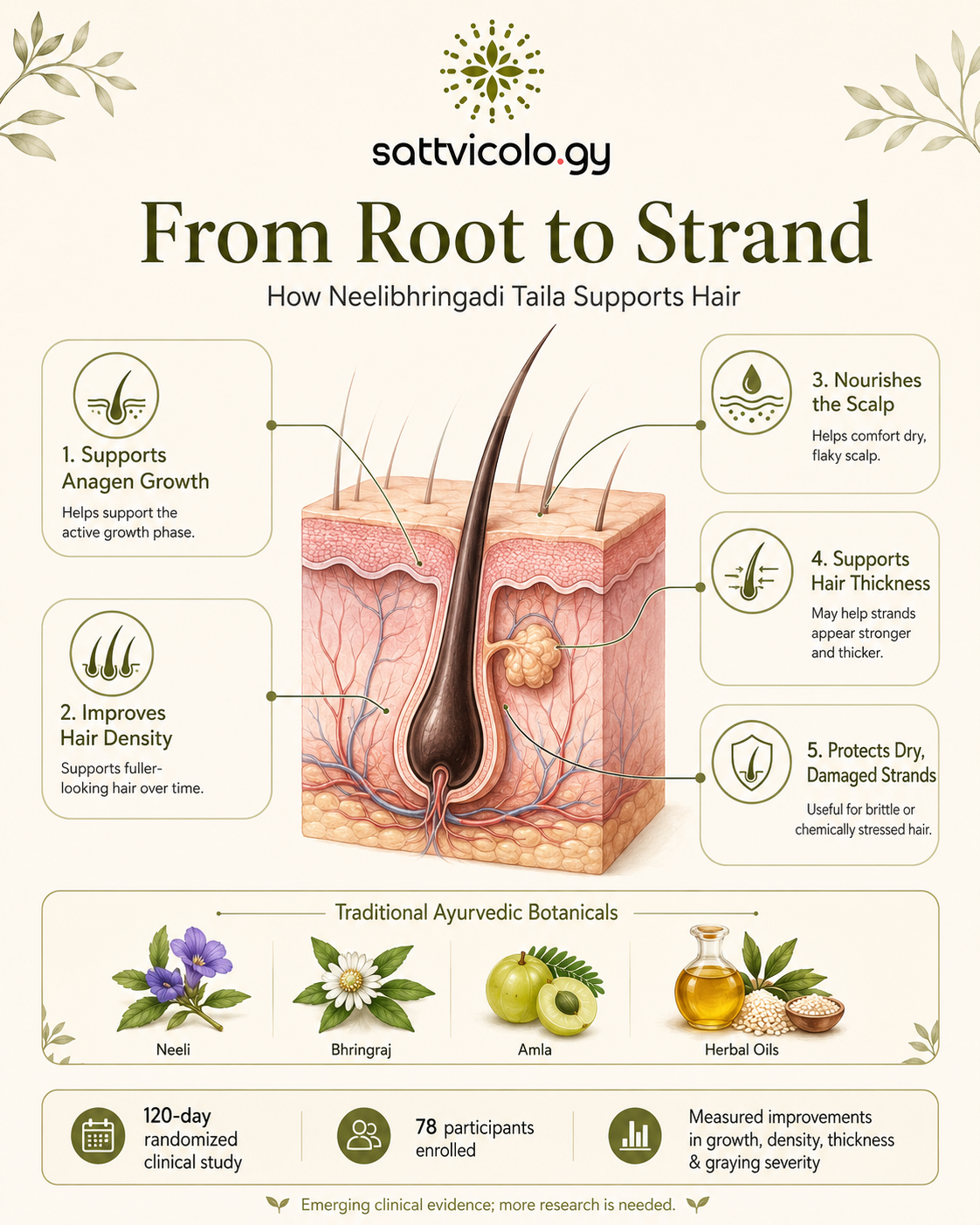
Why Is Neelibhringadi Taila Important in Ayurveda?
Ayurveda traditionally regards healthy hair as dependent upon adequate nourishment, appropriate metabolism and balanced doshas.
Khalitya, broadly associated with excessive hair loss or alopecic patterns, is traditionally connected with disturbances involving Pitta and Vata, while Kapha and other factors may influence obstruction and scalp physiology.
Palitya refers to premature graying. From the Ayurvedic perspective, excessive heat, stress, irregular lifestyle, inappropriate food, emotional strain and constitutional tendencies can contribute to premature changes in the hair.
The contemporary Neeli Bhringadi clinical paper frames Khalitya and hair disorders within disturbances of Vata and Pitta and impaired nourishment of the Romakupa, or hair follicle structures, while noting the classical use of medicated scalp oil application.
Modern biomedical science uses different terminology, but oxidative stress has been studied as one contributor to hair aging and pigmentation loss. This does not prove that antioxidant herbs reverse gray hair; it simply provides a plausible modern research context for studying traditional pigmentation-supporting formulations.
The 9 Most Important Potential Benefits of Neelibhringadi Taila
Neelibhringadi Taila sits at the intersection of traditional scalp care and emerging clinical investigation. The following potential benefits combine Ayurvedic use, the 2026 human trial and broader hair-fiber science.
Important: promising findings should not be interpreted as proof that every commercial Neelibhringadi product produces identical results or that the oil replaces diagnosis and medical treatment when hair loss has an underlying cause.
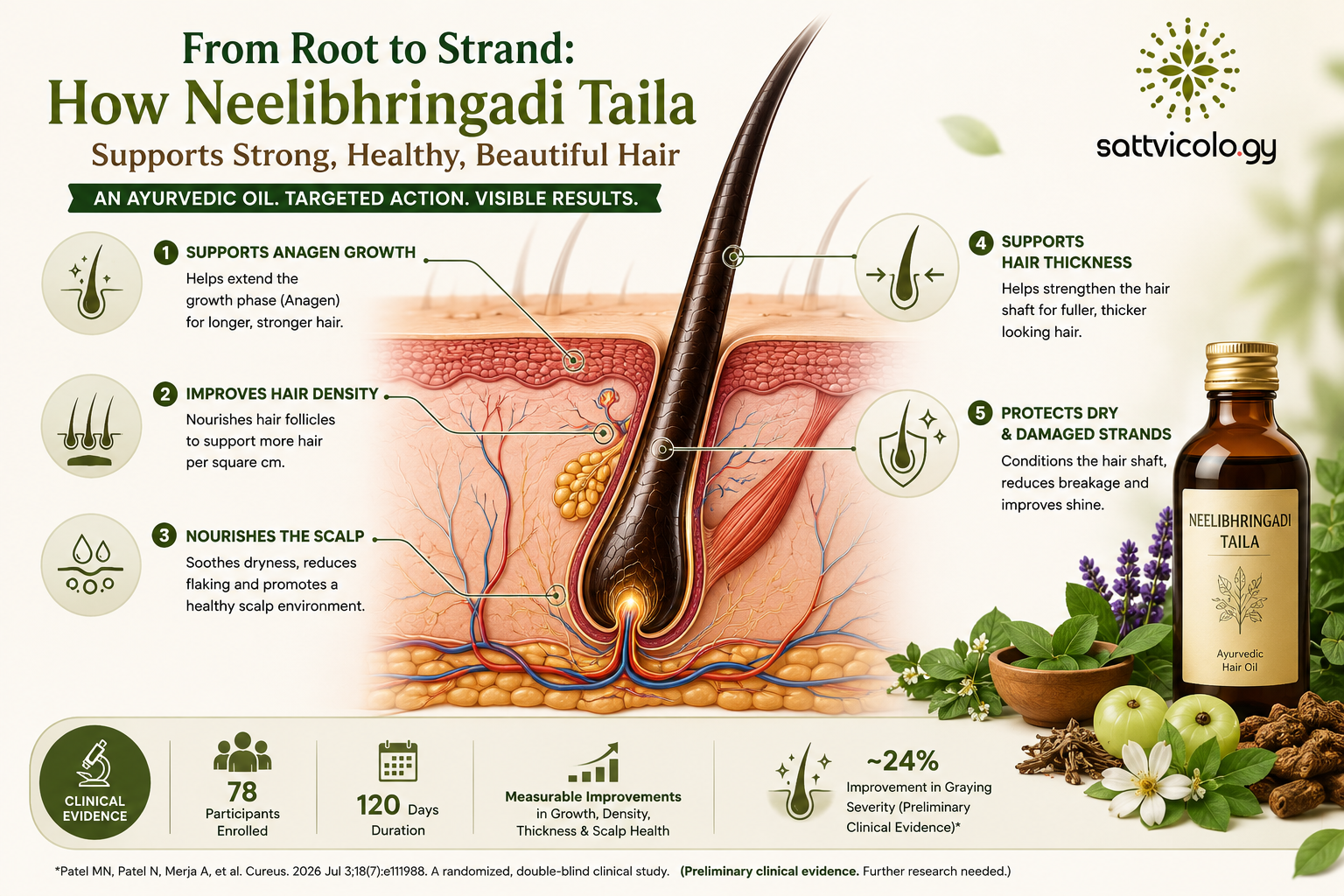
1. Supporting Hair Growth
Hair growth is the most obvious reason many people encounter Neelibhringadi Taila.
In the 2026 randomized clinical trial, 78 adults aged 18 to 55 were enrolled and 75 completed the 120-day study. Participants included people with androgenetic alopecia or excessive hair fall together with premature graying. They were randomized among Neeli Bhringadi polyherbal oil, the oil plus 5% minoxidil, or 5% minoxidil alone.
Participants using the oil alone applied it to the scalp three times weekly, massaged it in, left it overnight and washed it the following morning.
By Day 90, mean measured hair-growth rate in the oil-only group increased from approximately 249.9 to 290.3 micrometers per day, a within-group increase of about 17%.
This is encouraging human evidence, but it remains preliminary because it comes from one relatively small, single-center study.
2. Increasing Hair Density
The same clinical trial evaluated objective hair density.
Hair density in the Neeli Bhringadi oil group increased from approximately 240 hairs/cm² at baseline to 278 hairs/cm² at Day 120, corresponding to a reported increase of about 16.2%.
However, an important detail is that the difference in hair density between the oil-only group and the minoxidil-only group was not statistically significant at Day 120.
This means the study should not be interpreted as proving that Neelibhringadi Taila is superior to minoxidil for increasing hair density. It provides preliminary evidence that people using the tested formulation experienced measurable increases over their own baseline during four months of treatment.
3. Supporting Thicker Hair
Hair thickness also increased in the clinical study.
Mean hair thickness in the Neeli Bhringadi group increased from approximately 13.2 µm to 16.6 µm by Day 120, a reported increase of roughly 26% from baseline.
The study also reported statistically significant differences between the oil group and minoxidil group in hair-thickness measurements at Day 120.
These findings are particularly interesting for people whose concern is not simply the number of hairs, but the progressive miniaturization or apparent thinning of individual strands. They should still be treated as early evidence rather than confirmation that all commercial Neelibhringadi oils produce the same effect.
4. Premature Graying: The Most Intriguing Finding
Perhaps the most remarkable result of the 2026 trial involved premature graying.
Investigators used a standardized Graying Severity Score across different scalp regions. In participants using Neeli Bhringadi oil alone, the mean score fell from approximately 11.92 to 9.24, representing about a 24.2% reduction over 120 days.
By comparison, the minoxidil-only group showed an approximately 4.3% reduction. The between-group difference at Day 120 was reported as statistically significant.
A lower graying-severity score is not the same as proving that every existing white hair was permanently repigmented. One study also does not establish Neelibhringadi Taila as a proven treatment for all premature graying.
The responsible conclusion is that the formulation has promising early human evidence for improving measured premature-graying severity, while larger independent trials are still needed.
5. Supporting the Anagen, or Growth, Phase
Human hair follicles move through several phases. Anagen is the active growth phase, catagen is transitional and telogen is the resting phase.
In the Neeli Bhringadi trial, the oil-only group’s measured percentage of anagen hairs increased substantially by Day 120, while the proportion of telogen hairs decreased.
These results provide a plausible clinical connection between the traditional idea of a Keshya, or hair-supporting, formulation and measurable changes in hair-cycle parameters.
Bhringraj itself has also shown hair-growth activity in preclinical research using Eclipta alba extracts. Animal studies cannot establish human effectiveness, but they contribute biological plausibility for further investigation.
6. Scalp Flaking and Scalp Condition
Healthy hair does not exist independently of the scalp.
The 2026 trial measured scalp flaking using the Adherent Scalp Flaking Score. In the Neeli Bhringadi group, mean scores decreased from approximately 22.6 at baseline to 8.1 by Day 120, a reduction of about 63.7%.
Researchers also observed improvements in scalp condition and hydration during the treatment period.
These findings do not mean Neelibhringadi Taila should automatically be used to treat every case of dandruff. Persistent scalp flaking can arise from seborrheic dermatitis, psoriasis, fungal conditions, contact dermatitis and other disorders that require appropriate diagnosis.
7. Helping Dry, Rough or Brittle Hair
Ayurvedic hair oiling is not limited to the follicle. Oil also interacts directly with the hair shaft, which is especially relevant for people who color, bleach, straighten or frequently heat-style their hair.
The recent Neeli Bhringadi trial reported improvements in assessments involving hair smoothness, shine and overall appearance after repeated application.
Independent human-hair research comparing coconut, sunflower and mineral oil found that coconut oil significantly reduced protein loss from both damaged and undamaged hair, particularly when used before or after washing.
Some Neelibhringadi preparations contain coconut-derived components or coconut oil. The specific 2026 clinical formulation used processed sesame oil as its primary oil carrier and coconut milk as one ingredient. Coconut-oil research therefore supports the broader rationale for oiling damaged hair, but it is not direct proof that every Neelibhringadi formulation repairs chemical damage.
8. Hair Damaged by Bleaching and Dyeing
Can Neelibhringadi Taila repair bleached hair? It can potentially condition and protect the hair shaft, but the word “repair” needs qualification.
Bleaching chemically alters the hair fiber. Once structural damage has occurred, an oil cannot biologically regenerate dead keratin in the way living tissue heals.
What oils can do is reduce friction, improve lubrication, help limit protein loss, increase apparent smoothness and potentially reduce additional mechanical breakage.
For heavily color-treated or bleached hair, Neelibhringadi Taila may therefore be useful as part of a pre-shampoo oiling routine, particularly when the formulation contains a penetrative oil base. The strongest direct evidence for damaged-hair protein protection currently comes from coconut oil rather than Neelibhringadi Taila itself.
9. Hair Fall and Hair Strength
The distinction between hair shedding and hair breakage is extremely important.
Shedding occurs when a hair leaves the follicle. Breakage occurs when the shaft snaps. A person who bleaches their hair may appear to be “losing hair” while actually experiencing substantial shaft fracture. Someone with androgenetic alopecia may instead have follicular miniaturization, while telogen effluvium involves increased shedding from the root.
Neelibhringadi Taila may potentially support several aspects of hair quality through scalp conditioning and lubrication, while the 2026 study measured improvements across multiple follicular and cosmetic parameters.
But determining why someone’s hair is disappearing remains crucial. An oil cannot correct iron deficiency, thyroid disease, autoimmune alopecia, scarring alopecia or other systemic causes simply by being applied to the scalp.
The Classical Ingredients Behind Neelibhringadi Taila
The formulation evaluated in the recent randomized trial included Neeli (Indigofera tinctoria), Bhringraj (Eclipta alba), Satakratu Lata (Cardiospermum halicacabum), Amalaki (Phyllanthus emblica), Yashtimadhu (Glycyrrhiza glabra), Gunja root (Abrus precatorius), Anjana/Berberis extract, sesame oil, coconut milk and several traditional milk-processing ingredients.
Bhringraj is one of Ayurveda’s best-known Keshya botanicals. Preclinical studies have reported hair-growth-promoting activity from Eclipta alba preparations.
Amalaki, or amla, is rich in polyphenolic and antioxidant compounds and remains one of Ayurveda’s prominent Rasayana plants, although strong human evidence specifically proving topical amla oil regrows hair remains limited.
The formula illustrates an important Ayurvedic pharmaceutics principle: Neelibhringadi Taila is not simply Bhringraj dropped into oil. It is a processed polyherbal preparation in which multiple botanical juices, pastes and liquid media are incorporated into the lipid carrier.
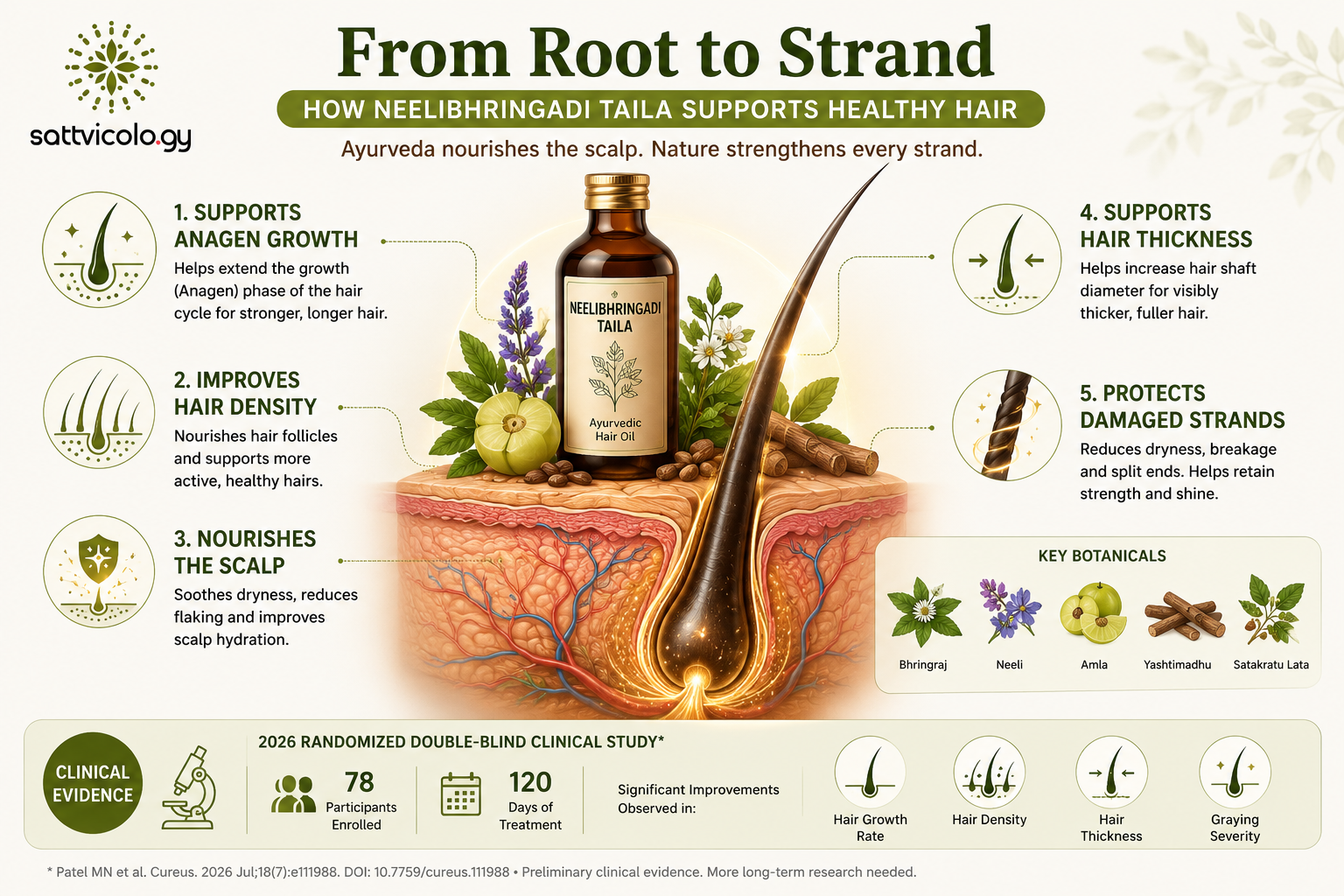
What Does the Best Human Clinical Trial Actually Prove?
This is the most important evidence section.
The 2026 Patel et al. study was prospective, randomized and described as double-blind. Allocation was generated by an independent biostatistician, products were placed in identical containers, and both participants and outcome assessors were reported to be unaware of group assignment. The study was prospectively registered and conducted over 120 days.
The Neeli Bhringadi oil-only group experienced statistically significant improvements from baseline in several measurements, including hair-growth rate, hair density, hair thickness, scalp condition and graying severity.
Scientific interpretation requires restraint. The study involved only 25 completers per arm, was conducted at a single center, lasted four months and primarily analyzed participants who completed the study.
Hair density did not show a statistically significant Day-120 advantage over minoxidil alone, while the graying-severity result was more distinctive. The evidence is promising, but long-term regrowth, permanent gray-hair reversal, superiority over established medical therapy and effectiveness of every commercial product remain unestablished.
Neelibhringadi Taila vs. Minoxidil
People searching for natural hair-growth options frequently ask whether Neelibhringadi Taila can replace minoxidil.
The evidence does not justify that conclusion.
In the recent head-to-head study, both treatments produced improvements in several hair measures. Hair density did not differ significantly between Neeli Bhringadi oil and minoxidil at Day 120.
Minoxidil remains one of the most extensively studied medical therapies for androgenetic alopecia. Neelibhringadi Taila has a much smaller evidence base.
The study therefore supports viewing the oil as an emerging integrative option, not as a proven replacement for dermatological therapy. Anyone with progressive androgenetic alopecia should discuss treatment early with a dermatologist.
Can Neelibhringadi Taila Reverse Gray Hair?
Neelibhringadi Taila has preliminary clinical evidence suggesting it may reduce the measured severity of premature graying, but it has not been proven to permanently reverse gray hair.
Premature graying is complex. Oxidative stress, melanocyte dysfunction and loss of melanocyte stem cells are among mechanisms being studied in hair pigmentation biology.
Premature graying can also sometimes be associated with underlying medical or nutritional factors, meaning unusually early or rapidly progressing graying should not automatically be treated as a cosmetic issue alone.
How to Use Neelibhringadi Taila
The protocol used in the 2026 human trial provides a useful evidence-based reference.
Participants applied the oil directly to the scalp with their fingertips, massaged it gently using circular motions, left the preparation overnight, washed it the following morning and repeated the routine three times per week for 120 days.
That does not automatically mean everyone needs the identical schedule. Someone with very fine hair, an oily scalp, seborrheic dermatitis or sensitivity may prefer shorter pre-shampoo application.
For chemically damaged lengths, a small amount may also be distributed through the mid-lengths and ends before washing, provided the product is well tolerated.
Consistency matters more than aggressively massaging the scalp. Hair follicles do not need to be rubbed hard to “activate” them.
Should You Heat Neelibhringadi Taila?
Traditional Ayurvedic scalp oiling commonly uses oil at a comfortable temperature.
It should never be excessively hot.
For people with very Pitta-sensitive scalps, inflammation, redness or heat intolerance, an Ayurvedic practitioner may prefer room-temperature or only slightly warmed oil rather than strongly heated oil.
If using the product on severely bleached hair, excessive heat is unnecessary and may add additional stress to already compromised hair fibers.
Is Neelibhringadi Taila Safe?
In the 2026 clinical trial, the Neeli Bhringadi formulation was reported as well tolerated, with no serious product-related adverse events identified during the study.
However, safety in one standardized research formulation does not prove that every commercial preparation is identical.
Some classical formulas contain ingredients such as Gunja (Abrus precatorius), a plant whose raw material requires appropriate traditional processing and professional manufacturing expertise. The clinical formulation used standardized, pharmacopeial-grade raw materials prepared under controlled conditions.
- Choose reputable, properly manufactured products.
- Do not attempt to reproduce complex classical formulas from raw herbs at home.
- Patch-test before broad scalp use if you have sensitive or reactive skin.
- Stop use and seek advice if significant irritation develops.
When Hair Loss Needs Medical Evaluation
Ayurvedic hair oil should complement diagnosis—not delay it.
Sudden shedding, rapidly widening parts, bald patches, scalp inflammation, scarring, eyebrow loss, significant itching, scaling, pain or hair loss accompanied by systemic symptoms should be professionally evaluated.
The 2026 clinical study itself excluded people whose hair loss was linked to conditions such as anemia or thyroid disorders, underscoring the importance of separating primary hair disorders from underlying medical causes.
Premature graying can also deserve evaluation when it occurs unusually early or changes rapidly.
The Sattvic Perspective: Hair Is More Than a Cosmetic Structure
Modern culture tends to treat hair only after it changes. We color the gray, conceal thinning, straighten what feels unruly, bleach and heat-style—and then search for something that will “fix” the result.
Ayurveda asks a different question: What environment are we creating for the hair every day?
The scalp is living tissue. The visible hair shaft is not. Healthy hair care therefore involves two complementary strategies: supporting the living follicle and protecting the nonliving fiber.
Neelibhringadi Taila sits naturally at that intersection. Its herbs belong to Ayurveda’s centuries-old tradition of scalp and hair care. Its lipid matrix conditions the hair fiber. Emerging human research now provides preliminary evidence that a standardized Neeli Bhringadi formulation may influence measurable parameters involving growth, density, thickness, scalp health and premature graying.
The traditional wisdom is old. The clinical investigation is only beginning.
Evidence Summary
Traditional Ayurvedic use: Strong historical tradition for Khalitya, Palitya and general hair/scalp nourishment.
Human evidence for hair growth: Promising preliminary evidence from one randomized 120-day clinical trial.
Human evidence for hair density: The oil group improved significantly from baseline, but was not statistically superior to minoxidil for Day-120 hair density.
Human evidence for premature graying: Particularly promising; the oil group showed an approximately 24% reduction in Graying Severity Score, with a significant Day-120 difference versus minoxidil. Replication is still required.
Evidence for chemically damaged hair: Direct Neelibhringadi-specific clinical evidence remains limited. Independent human-hair research supports coconut oil for reducing protein loss in damaged fibers.
Evidence that it permanently reverses baldness or gray hair: Not established.
Clinical & Scientific References
Patel MN, Patel N, Merja A, et al. An Integrative Approach of Neeli Bhringraj Polyherbal Hair Oil in Clinical Evaluation of Androgenetic Alopecia (Khalitya) and Premature Hair Graying (Palitya): A Randomized, Double-Blind Clinical Study. Cureus. Published July 3, 2026. DOI: 10.7759/cureus.111988.
Roy RK, Thakur M, Dixit VK. Experimental research evaluating Eclipta alba reported hair-growth-promoting activity in preclinical models.
Rele AS, Mohile RB. Research comparing coconut, sunflower and mineral oil demonstrated that coconut oil reduced protein loss from damaged and undamaged human hair.
Research into premature graying has also identified oxidative stress, melanocyte dysfunction and melanocyte stem-cell biology as important areas of investigation.
Frequently Asked Questions About Neelibhringadi Taila
Neelibhringadi Taila is a classical Ayurvedic polyherbal scalp and hair oil built around botanicals such as Neeli and Bhringraj. Traditional Ayurveda uses it for hair fall, premature graying and scalp nourishment. A standardized Neeli Bhringadi formulation was evaluated in a randomized 2026 human clinical study.
A randomized 120-day study found that participants using a Neeli Bhringadi polyherbal oil experienced significant increases from baseline in hair-growth rate, hair density and hair thickness. Because this is one relatively small clinical trial, further independent research is needed.
The 2026 trial reported an approximately 24% improvement in Graying Severity Score in the oil-only group over 120 days, with a significant Day-120 difference versus minoxidil on this measure. This does not prove permanent reversal of every gray hair.
The clinical trial evaluated regular use over 120 days. Hair-growth rate was measured at Day 90, while many other outcomes were evaluated through Day 120. Hair biology is slow, so meaningful evaluation generally requires months rather than days.
In the 2026 clinical trial, participants applied the oil three times per week, left it on overnight and washed it out the next morning. Individual needs may differ depending on scalp condition and hair type.
Yes. Overnight application was the protocol used in the recent clinical study. People with sensitive, acne-prone or very oily scalps may prefer shorter contact times after appropriate guidance.
Current evidence does not establish that conclusion. Hair density improved in the oil group, but the Day-120 difference between the Neeli Bhringadi and minoxidil groups was not statistically significant. Premature-graying severity showed a more favorable signal for the oil.
It may help condition and lubricate damaged hair, but direct clinical evidence specifically testing Neelibhringadi Taila on bleached hair is lacking. Independent research shows that coconut oil can reduce protein loss from damaged human hair.
The recent clinical trial reported favorable changes across multiple hair-growth and scalp parameters, but hair fall has many causes. The oil cannot be expected to correct hair loss caused by untreated thyroid disease, anemia, autoimmune conditions or scarring alopecia.
Bhringraj oil may refer to a simpler product centered primarily on Eclipta alba. Neelibhringadi Taila is a more complex polyherbal Ayurvedic preparation combining Bhringraj with Neeli and other traditional ingredients processed into an oil medium.
In Ayurvedic terminology, Khalitya refers broadly to hair-loss or alopecic patterns, while Palitya refers to premature graying. These traditional concepts should not be assumed to correspond exactly to a single modern dermatological diagnosis.
The standardized formulation used in the 2026 randomized study was reported as well tolerated without serious product-related adverse events. Commercial formulations vary, so choose reputable products and patch-test before widespread scalp application if you are sensitive.
Explore Ayurveda Thoughtfully
Neelibhringadi Taila is traditionally selected as part of a broader Ayurvedic understanding of constitution, scalp condition, doshic tendencies and hair quality. Explore Ayurveda and consult a qualified practitioner when you need individualized guidance.
Medical Disclaimer
This article is educational and discusses traditional Ayurvedic practice alongside emerging scientific evidence. It is not intended to diagnose, treat, cure or prevent disease. Hair loss can be caused by genetic, endocrine, nutritional, inflammatory, autoimmune, medication-related and other medical conditions. Persistent, rapid or unexplained hair loss should be evaluated by an appropriate healthcare professional.