Shilajit: 10 Potential Benefits of Ayurveda’s Legendary Rasayana
Siddharth Bhairava,
BAMS, Certified Ayurvedic Provider.
Sattvicology Healthcare Team
Shilajit is a naturally occurring phyto-mineral substance used in Ayurveda as a rasayana. Explore what human clinical research says about testosterone, male fertility, muscle fatigue, collagen, bone health, oxidative stress, safety and purity.
What Is Shilajit?
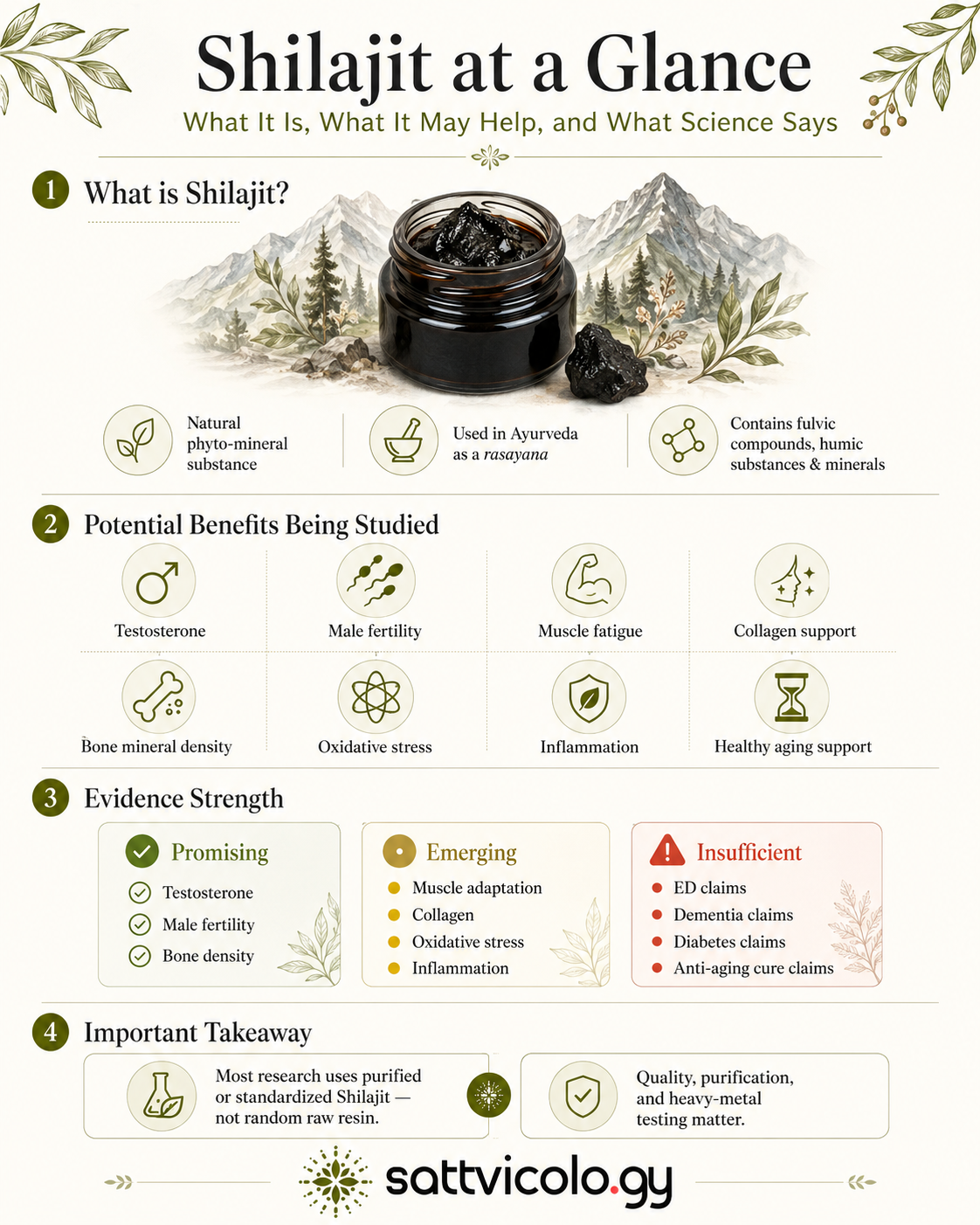
Shilajit is a complex natural phyto-mineral substance found primarily in mountainous regions. It is sometimes called Mumie, Moomiyo, Mummiyo or mineral pitch.
Unlike a single herb or isolated drug molecule, Shilajit contains a complex mixture of humic substances, fulvic compounds, dibenzo-alpha-pyrones and related compounds, organic molecules, minerals and trace elements. Its exact composition varies substantially according to geography, geology, processing and purification.
Quick answer: Human clinical research suggests that purified or standardized Shilajit may have potential benefits involving testosterone in selected middle-aged men, male reproductive health, exercise-related muscle fatigue, skeletal-muscle adaptation, collagen-related biomarkers and preservation of bone mineral density in some postmenopausal women. Evidence remains limited, and product quality is especially important.
Fulvic Acid, Rasayana and Why Shilajit Is Different
What is fulvic acid in Shilajit?
Fulvic acid is one of the compounds most frequently associated with Shilajit. Fulvic substances form through long-term breakdown and transformation of organic material, and scientific reviews suggest they may contribute to some of Shilajit’s biological properties.
Claims such as “fulvic acid detoxifies every cell” or “Shilajit delivers 85 minerals directly into your cells” should be treated cautiously because composition varies and many marketing statements go beyond human clinical evidence.
Why is Shilajit considered a rasayana?
In Ayurveda, rasayana refers to a broad rejuvenative tradition associated with vitality, strength, nourishment, resilience, reproductive vitality, healthy aging and recovery. Modern terms such as “adaptogenic,” “mitochondrial” or “antioxidant” may overlap with some research themes, but they are not exact translations of rasayana.
1. Shilajit May Influence Testosterone in Men
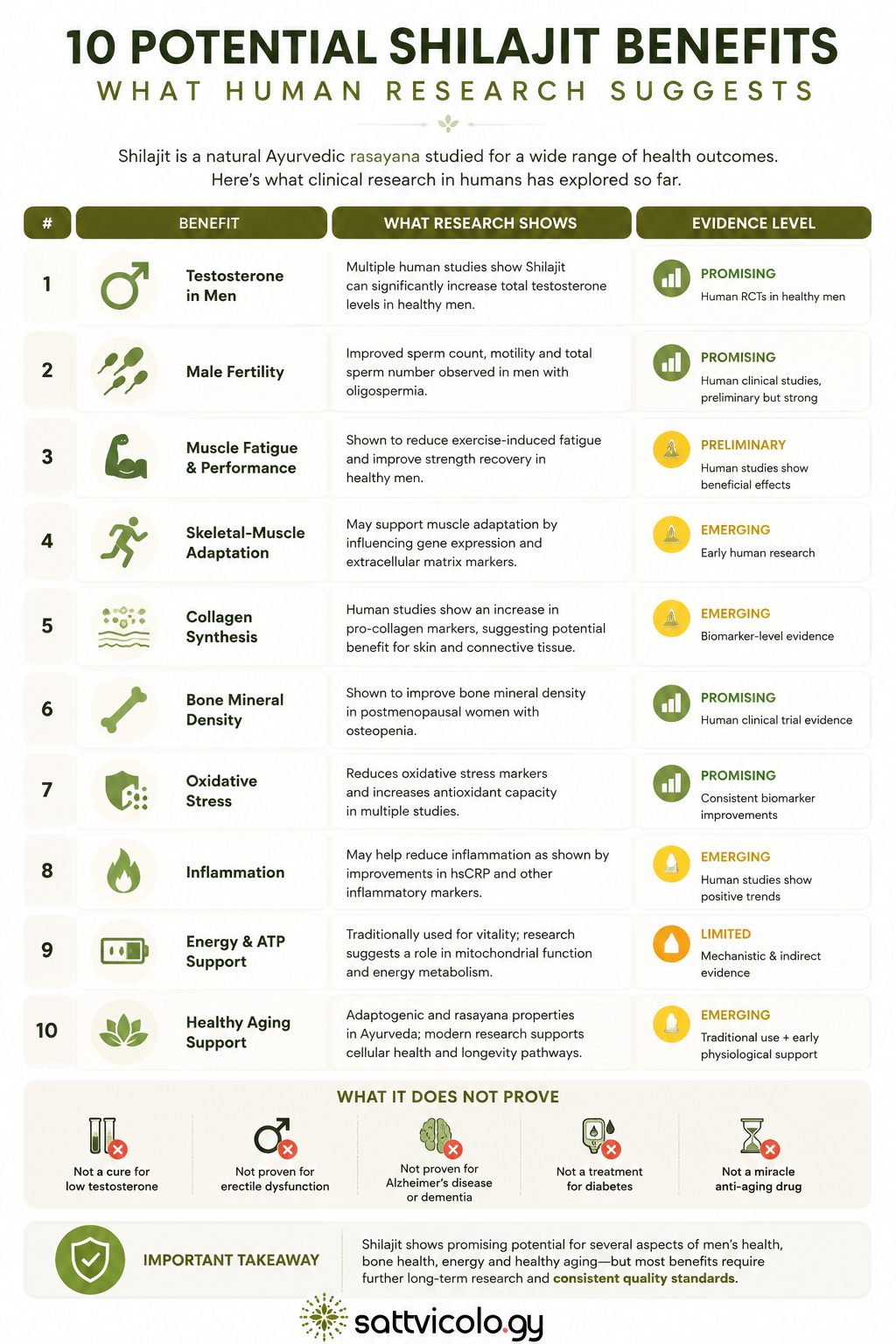
A randomized, double-blind, placebo-controlled trial evaluated purified Shilajit in healthy men aged 45 to 55 years. Participants received 250 mg twice daily for 90 days. Researchers reported significant increases in total testosterone, free testosterone and DHEAS compared with placebo, while luteinizing hormone and follicle-stimulating hormone remained maintained.
Evidence level: Promising but limited. This was one relatively small trial involving a specific purified preparation and age group. It does not establish that Shilajit treats medically diagnosed hypogonadism, replaces testosterone therapy or raises testosterone in every person.
2. Shilajit May Support Male Fertility
A clinical study evaluated processed Shilajit in men with oligospermia. Thirty-five men were enrolled and 28 completed 90 days of treatment. Researchers reported improvements compared with baseline in sperm concentration, total sperm count, sperm motility and the percentage of morphologically normal sperm. Testosterone increased and seminal oxidative-stress markers decreased.
Evidence level: Promising but preliminary. The study was not a large placebo-controlled infertility trial, and improving semen measurements is not the same as proving improved pregnancy or live-birth rates.
3. Shilajit May Help Resist Muscle Fatigue
A randomized trial in 63 recreationally active men compared placebo with 250 mg/day and 500 mg/day of Shilajit for eight weeks. The higher-dose group showed a smaller fatigue-related decline in maximal muscular strength in selected analyses.
Evidence level: Preliminary but clinically interesting. Shilajit has not been established as a proven athletic-performance supplement and does not replace adequate calories, protein, sleep, hydration, resistance training or recovery.
4. Shilajit May Influence Skeletal-Muscle Adaptation
A human study gave overweight and class I obese adults 250 mg twice daily for eight weeks, followed by four weeks involving exercise. Skeletal-muscle biopsies showed increased expression of genes related to extracellular-matrix biology, including collagen, elastin, fibronectin and fibrillin.
Evidence level: Mechanistically interesting but early. These molecular changes do not prove that Shilajit substantially increases muscle mass or athletic performance.
5. Shilajit May Support Collagen-Related Processes
Collagen is a major structural protein in bone, tendons, ligaments, skin, connective tissue and muscle extracellular matrix. A randomized trial examined Shilajit and a biomarker of type I collagen synthesis called Pro-c1α1, while earlier muscle-biopsy research also identified changes in genes involved in collagen and extracellular-matrix biology.
Evidence level: Emerging. These findings should not be translated into unsupported claims that Shilajit reverses wrinkles, regrows cartilage or repairs tendon injuries.
6. Shilajit May Help Preserve Bone Mineral Density
A randomized trial evaluated 60 postmenopausal women aged 45–65 with osteopenia. Participants received placebo, 250 mg/day standardized Shilajit extract or 500 mg/day for 48 weeks. Bone mineral density was assessed at the lumbar spine and femoral neck. Women receiving Shilajit had significantly attenuated bone loss compared with placebo, with favorable changes also reported in selected bone-turnover, oxidative-stress and inflammatory markers.
Evidence level: Promising but requires replication. Shilajit is not an established treatment for osteoporosis and should not replace appropriate fracture-risk evaluation or prescribed therapy.
7. Shilajit May Influence Oxidative Stress
Laboratory research has long investigated Shilajit’s antioxidant potential. Human studies have also measured oxidative-stress biomarkers. The male fertility study reported lower malondialdehyde after processed Shilajit, and the postmenopausal osteopenia trial reported favorable changes in oxidative-stress markers.
Evidence level: Promising for biomarkers. Improving an antioxidant biomarker is not the same as proving prevention of heart disease, cancer, dementia or aging.
8. Shilajit May Influence Inflammation
Inflammatory pathways have also been examined in Shilajit research. The postmenopausal bone study measured high-sensitivity C-reactive protein and reported favorable effects alongside attenuation of bone loss. Laboratory studies suggest additional anti-inflammatory mechanisms, but much of that evidence remains preclinical.
Evidence level: Preliminary to emerging. Shilajit should not be described as a treatment for rheumatoid arthritis, inflammatory bowel disease, autoimmune disease or other chronic inflammatory disorders without condition-specific human evidence.
9. Shilajit and Energy: Does It Increase ATP?
One of the most popular Shilajit claims is that it “boosts ATP” or increases cellular energy. Scientific reviews discuss constituents such as dibenzo-alpha-pyrones and fulvic substances in relation to mitochondrial function and energy metabolism, while human studies involving muscle fatigue and muscle gene expression provide indirect support for investigating this hypothesis.
Evidence level: Mechanistically promising; clinical evidence remains limited. Shilajit has not been established as a treatment for mitochondrial disease or chronic fatigue syndrome.
10. Shilajit May Support Healthy Aging
Shilajit has traditionally been considered a rasayana, which naturally leads to modern interest in healthy aging. Research themes involving testosterone, bone mineral density, collagen synthesis, muscle adaptation and oxidative stress make Shilajit scientifically interesting in this context.
There is no human clinical trial showing that Shilajit extends lifespan, reverses biological aging, prevents dementia or prevents all age-related disease. “Supports healthy aging” is more defensible than “anti-aging miracle.”
Shilajit Through an Ayurvedic Lens
In Ayurveda, Shilajit is not simply viewed as a testosterone supplement or energy booster. It is traditionally discussed in a broader framework involving rasayana, strength, vitality, metabolic balance, reproductive health, healthy aging and recovery.
An Ayurvedic practitioner may consider Prakriti, Vikriti, Vata, Pitta, Kapha, Agni, Ama, appetite, digestion, elimination, sleep, strength, age, current disease state, medications, other herbs and lifestyle.
At Sattvicolo.gy, the more appropriate question is whether purified Shilajit fits the individual person’s constitution, health goals, medications, digestive function, laboratory findings and overall health condition.
Raw Shilajit vs. Purified Shilajit
Raw Shilajit
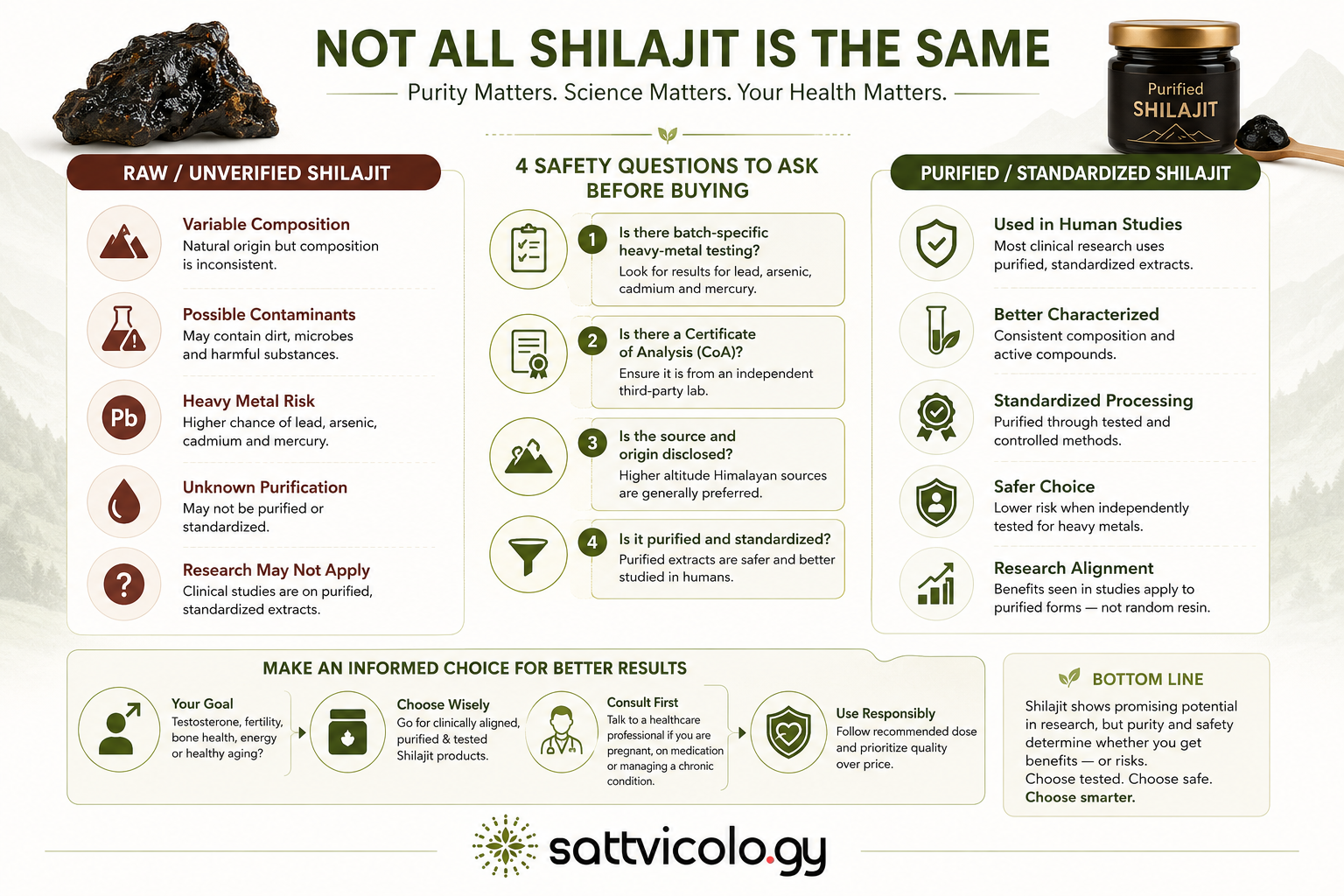
Unprocessed material may contain soil-derived material, variable mineral concentrations, microbial contaminants, unwanted metals and other environmental material.
Purified Shilajit
Proper processing attempts to remove unwanted components while retaining desired constituents. Most credible modern clinical research uses processed, purified or standardized Shilajit, not random untested raw resin purchased online.
Clinical trial results involving standardized purified Shilajit cannot automatically be generalized to every commercial Shilajit product.
Is Shilajit a Herb?
Technically, calling Shilajit an “Ayurvedic herb” is convenient but imprecise. Shilajit is better described as a natural phyto-mineral substance used in Ayurvedic medicine. It contains organic compounds as well as minerals originating from its geological environment.
What Is Himalayan Shilajit?
Shilajit is strongly associated with the Himalayan region, although Shilajit-like materials occur in multiple mountainous areas internationally. The word “Himalayan” should describe verified provenance rather than simply function as a marketing term.
A product labeled Himalayan Shilajit is not automatically more pure, more effective, heavy-metal free, authentic or clinically tested. Testing matters more than mountain imagery on the packaging.
Shilajit and Testosterone: What Men Should Know
Shilajit is heavily marketed as a natural testosterone booster. There is legitimate human research behind that claim, but marketing often exaggerates what the trial demonstrated. One randomized placebo-controlled study found higher testosterone after 90 days in healthy men aged 45–55 taking purified Shilajit.
That does not mean Shilajit treats pituitary disease, corrects testicular failure, replaces medically indicated testosterone therapy or treats erectile dysfunction. Symptoms attributed to “low T” can have many causes and deserve appropriate evaluation.
Shilajit and Female Health
Shilajit is often marketed primarily to men, but it has also been studied in women. The 48-week randomized clinical trial in postmenopausal women with osteopenia reported attenuation of bone mineral-density loss compared with placebo.
However, there is insufficient clinical evidence to claim that Shilajit balances female hormones, treats menopause, treats PCOS, increases female fertility or treats low libido in women.
Shilajit and Heavy Metals: The Most Important Safety Issue
Because Shilajit forms within geological environments, it naturally contains numerous elements. A 2024 review identified a broad range of metals reported in Shilajit and emphasized that inappropriate concentrations of toxic metals such as lead, arsenic, cadmium and mercury could pose health risks.
A 2026 analytical study of 12 geographically diverse Shilajit samples also found meaningful differences in elemental profiles. Toxic metals in those specific samples remained below established toxicity thresholds, but the variability illustrates why source-specific testing matters.
Consumers should not assume that appearance, origin or “raw” labeling proves purity.
How to Choose a Shilajit Product
For Shilajit, quality testing may be as important as the ingredient itself. Look for a manufacturer that can provide batch-specific independent laboratory testing.
- Lead, mercury, arsenic and cadmium testing
- Microbial contamination testing
- Product identity and purity testing
- Clearly identified processing method
- Country or region of origin
- Transparent ingredient listing
- Manufacturing traceability
Ideally, the certificate of analysis should correspond to the actual lot number being sold. Terms such as “Himalayan,” “ancient,” “raw,” “natural,” “premium” or “gold grade” do not replace laboratory analysis.
What Does Modern Science Actually Say About Shilajit?
Evidence is promising for:
- Testosterone in selected middle-aged men
- Male reproductive parameters
- Bone-density preservation in postmenopausal osteopenia
- Selected exercise-related muscle-fatigue outcomes
Evidence is emerging for:
- Skeletal-muscle adaptation
- Collagen-related physiology
- Oxidative-stress biomarkers
- Inflammatory biomarkers
Evidence is insufficient for claiming that Shilajit:
- Cures low testosterone or infertility
- Treats erectile dysfunction
- Treats chronic fatigue syndrome
- Reverses Alzheimer’s disease or prevents dementia
- Treats diabetes or cancer
- Cures osteoporosis
- “Detoxifies” every organ
- Reverses aging or extends lifespan
- Balances every hormone
Human clinical research is interesting but still relatively small. Condition-specific medical treatment should not be replaced with Shilajit based on preliminary evidence.
The Sattvicolo.gy Perspective
Shilajit is fascinating because it sits at the intersection of ancient Ayurveda, geological complexity, modern nutritional science, hormones, bone, muscle and healthy aging.
The internet increasingly presents it as “nature’s testosterone,” “the ultimate male supplement,” a “mitochondrial miracle” or a natural anti-aging drug. The clinical evidence is more nuanced. Purified Shilajit has demonstrated meaningful signals in several human studies, but the evidence base remains relatively small and quality control may determine whether a commercial product resembles the standardized preparations used in research at all.
Ayurveda is not simply about adding more supplements. It is about determining what is appropriate for the individual—and using it appropriately.
Research References
- Pandit S, Biswas S, Jana U, et al. Clinical evaluation of purified Shilajit on testosterone levels in healthy volunteers. Andrologia. 2016;48(5):570-575.
- Biswas TK, Pandit S, Mondal S, et al. Clinical evaluation of spermatogenic activity of processed Shilajit in oligospermia. Andrologia. 2010;42(1):48-56.
- Keller JL, Housh TJ, Hill EC, et al. The effects of Shilajit supplementation on fatigue-induced decreases in muscular strength and serum hydroxyproline levels. J Int Soc Sports Nutr. 2019;16:3.
- Das A, Datta S, Rhea B, et al. The Human Skeletal Muscle Transcriptome in Response to Oral Shilajit Supplementation. J Med Food. 2016;19(7):701-709.
- Shilajit extract reduces oxidative stress, inflammation, and bone loss to dose-dependently preserve bone mineral density in postmenopausal women with osteopenia: a randomized, double-blind, placebo-controlled trial. 2022.
- Effects of 8 Weeks of Shilajit Supplementation on Serum Pro-c1α1, a Biomarker of Type 1 Collagen Synthesis: A Randomized Control Trial.
- Stohs SJ. Safety and efficacy of Shilajit (mumie, moomiyo). Phytother Res. 2014;28(4):475-479.
- Hussain A, Saeed A. Hazardous or Advantageous: Uncovering the Roles of Heavy Metals and Humic Substances in Shilajit with Emphasis on Heavy Metals Toxicity and Their Detoxification Mechanisms. Biol Trace Elem Res. 2024;202:5794-5814.
- Kamgar E, et al. Characterization of metal composition and molecular weight distribution in Shilajit. J Trace Elem Med Biol. 2026;96:127913.
- National Center for Complementary and Integrative Health. Ayurvedic Medicine: In Depth.
Frequently Asked Questions About Shilajit
Shilajit is a naturally occurring phyto-mineral substance traditionally used in Ayurveda as a rasayana. It contains humic substances, fulvic compounds, minerals and numerous organic constituents, and its composition varies by source and processing.
Human research suggests potential benefits involving testosterone in selected middle-aged men, male reproductive parameters, muscle-fatigue resistance, collagen-related biomarkers, skeletal-muscle adaptation and preservation of bone mineral density in some postmenopausal women.
One randomized, double-blind, placebo-controlled trial in healthy men aged 45–55 found increases in total testosterone, free testosterone and DHEAS after 90 days of purified Shilajit. More independent research is needed before it can be considered a treatment for clinically low testosterone.
A small clinical study in men with oligospermia reported improvements in sperm count, concentration, motility and other semen parameters after 90 days. It did not prove improved pregnancy or live-birth rates.
Human studies provide preliminary evidence relating Shilajit to muscle fatigue and skeletal-muscle adaptation, while mechanistic research explores mitochondrial and energy-related pathways. It is not an established treatment for chronic fatigue syndrome or mitochondrial disease.
A 48-week randomized trial in 60 postmenopausal women with osteopenia found that standardized Shilajit extract attenuated decreases in lumbar-spine and femoral-neck bone mineral density compared with placebo.
Yes. Fulvic substances are important components of Shilajit and are frequently studied in connection with its biological properties. Their concentration can vary by source.
Shilajit naturally contains numerous elements because of its geological origin. Published research documents variability between samples, which is why product-specific third-party testing for lead, arsenic, cadmium and mercury is important.
Himalayan describes geographical origin, not necessarily quality. Purity, processing, authentication, standardization and independent contaminant testing are more useful quality indicators.
There is no clinical evidence that raw Shilajit is superior. Most human clinical research uses processed, purified or standardized preparations.
Shilajit has been studied in women, including a randomized trial involving postmenopausal women with osteopenia. Evidence for pregnancy, breastfeeding, reproductive-age women and many female hormonal conditions remains insufficient.
High-quality clinical evidence showing that Shilajit treats erectile dysfunction is lacking. Persistent erectile dysfunction should receive appropriate medical assessment.
Specific purified preparations have been used daily in human trials lasting from several weeks to 48 weeks. This does not establish lifelong safety or the safety of every commercial product.
Visual appearance, taste or internet purity tests cannot reliably establish safety. Look for product identity testing and a current batch-specific certificate of analysis covering heavy metals and microbiological contamination.
Explore Ayurveda With Individualized Guidance
Shilajit is traditionally selected according to the individual rather than treated as a universal supplement. Explore personalized Ayurvedic guidance with Sattvicolo.gy.
Medical Disclaimer
The information provided on Sattvicolo.gy is for educational and informational purposes only. It is not intended to diagnose, treat, cure or prevent disease and should not replace professional medical advice, laboratory testing, diagnosis or treatment.
Shilajit is a complex natural substance whose composition may vary according to geographic source, processing, purification and manufacturing practices. Use only appropriately purified products supported by reliable batch-specific contaminant testing.
Do not use Shilajit as a substitute for treatment for low testosterone, infertility, erectile dysfunction, osteoporosis, diabetes, cardiovascular disease, chronic fatigue, cognitive impairment or hormonal disorders. If you are pregnant, breastfeeding, attempting conception, taking prescription medication, preparing for surgery, or living with a chronic medical condition, consult an appropriately qualified healthcare professional before use.